White folks, a school and recess.

20 05 2012

One hundred pairs of wide brown eyes stared at us like we had just landed in their corner of Ivory Coast from the moon: Two women with pale skin, smiling.
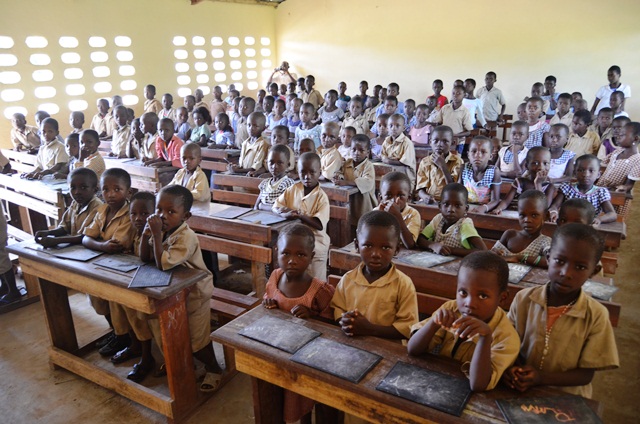
The classroom.

These two strange-looking women were accompanied by a third woman, carrying a leather handbag, who looked like they themselves did, or rather like their mothers, just better dressed. And better fed.

We felt a bit like we were in a zoo: the grown-ups showed us what was there, in the classroom, and the hundred kids got to take a good long look at what had just walked in the door.

The question was only – which of us was the caged animal?

Perhaps they had seen white people like us before, but likely only men, and only in a position of power. A foreman on a rubber plantation where their parents worked as day-labor, or a buyer for the cocoa that their parents harvested on their smallholder farm. In both cases the white man determined what they would eat, and if they could afford to go to school, or to a doctor. Today or tomorrow. Or never.

The principal of the rural primary school about 150 kilometers east of Abidjan opened his doors wide for the visitors from far-away Europe. The children stood for us, bade us good morning in unison, and then sang for us. And they stared at us. It was a strange feeling, being greeted like royalty, or the President.

A goat munched serenely on weeds near the flagpole. A natural lawnmower today, lunch (if necessary) tomorrow.

The schoolyard (with goat and woman).

The school has three classrooms for the 180 kids currently enrolled, a small office for the principal, housing for the teachers – including solar cells on the roof for electricity – and a water well in the barren schoolyard.

The youngest kids looked to be about 6 or 7 – the age where most children in most countries start school. But the one or the other stood much taller than her comrades. A teacher told us later that these were the kids who lived farthest away, and whose parents didn’t let them begin first grade until they were 10 or 11.

Some kids, the principal said, just do not show up during the harvest of whatever crop their parents or neighbors farm. Other children attend for a year, but don’t come back when the new term starts. The teachers are used to this, and have no choice but to accept it as part of this traditional, agricultural society, where child labor (and child slavery) is not uncommon. Often the parents are illiterate, and don’t know better.

During our visit, the principal promised the kids that if they are really good students, and work very, very hard, then someday they can get on a big airplane and fly to where these two strange-looking women came from.

The older kids laughed, knowing full well this was something that maybe a single lucky one of them might experience in a lifetime. The younger ones seemed more bewildered than anything else. They didn’t seem to find this funny – or a state to which they would really wish to aspire. An uncomfortable, confused silence followed. We kept the smiles pasted on our faces so that we didn’t have to say anything – because we had no words at that moment.

At mid-morning a small child ran out of one classroom, grabbed a stick and banged on the rim of an old truck tire that had been stripped of its rubber, hanging on a wooden frame in the middle of the schoolyard.
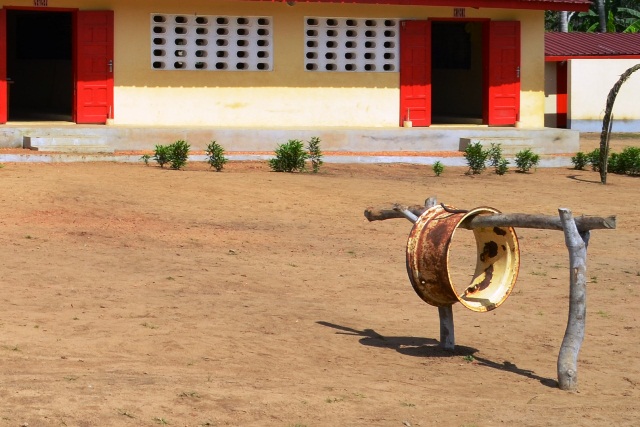
The bell.

And then we saw what happens at recess at probably every rural primary school in Cote d’Ivoire. And all over the world.

180 kids + break-time = boundless energy.



Three women of Africa

11 05 2012

The first woman is cocoa farmer, grasping a rare opportunity to learn.

On this overcast day she joins two dozen men of her community in an educational program that promises to help her grow more cocoa pods, and deliver higher-quality beans that will be used for exclusive foreign chocolate and enjoyed in sophisticated European capitals that she will never see. She hopes to apply the things she learns on her own farm, to generate a higher income, and build a better life. She squats on the ground in her flip-flops and mixes a pile of freshly shucked cocoa beans, up to her elbows in the white pulp that tastes a little like lychee juice.

She sings while she works.

Womens’ work.

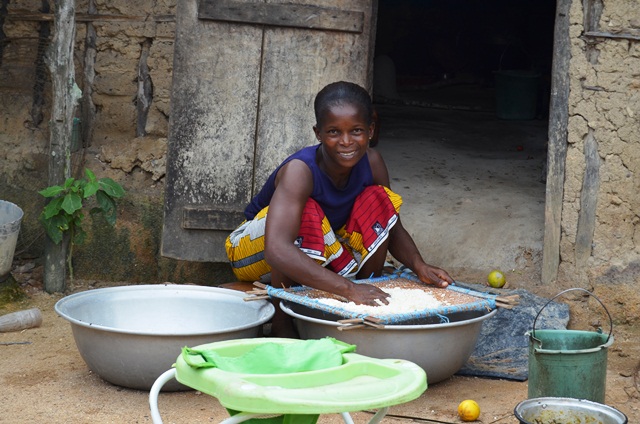
The second woman is a villager, grinding manioc on the doorstep of her mud-and-wattle home, to feed her family.

Her settlement is in a clearing in the rainforest, a red dirt piste the only connection to the main road, several miles away. To get there, we drive slalom around potholes wide enough to easily throw out an axle, and deep enough to easily swallow an entire car. These homes have no running water or electricity, and the roofs are made of dried palm leaves.

She tastes some of the chocolate we bring from far-away Europe. It is soft and runny, from the heat, but she takes a handful anyway, and sucks it off her fingers.

Womens’ work.

The third woman is not a woman at all. She is a child of maybe 13 or 15 years old, who has, herself, just borne a child, a few hours earlier. He lies next to her on the plastic-covered bed, stretching his arms skyward, to hug his new world, while she rests. The doctor at the rural health center tells us that the birth took place without anesthesia. “Natural childbirth,” they call it here. To get to the clinic at the top of the hill she had to walk. Her own mother, barely 30, accompanied her. She is now a grandmother.

I did not photograph them.

**********

These are three of the women I met last week in Ivory Coast, a country of 21 million inhabitants nestled between Liberia and Ghana in Western Africa. “Met” is perhaps an exaggeration. I don’t know much more about these women than the basic facts I have written down here, hastily scribbled into my reporters’ notebook at the time. I don’t even know their names. We exchanged a handshake, a “Bonjour madame!”, a smile, and a laugh at something silly. Our worlds touched briefly, with that bond dispersing a short time later, just as quickly.

These are three of the strong women of Africa.

She is the backbone of her community, she is the keeper of her family. Here in the rural communities of the Ivory Coast, she learns from an early age that she must embrace hard physical work to survive. And that she must endure the constant machismo of a traditional male-dominated society, where polygamy is regularly practiced and inheritance usually only passes to her brothers. She bears these lifelong hardships with dignity.

Every day she has a million miles to go before she can sleep.

This was my first visit to Western Africa, and it will surely not be my last. My body returned to Europe this morning. My soul is having a hard time keeping up.

Womens’ work.


Oh, Chicago!

15 04 2012

One of the Dalai Lama’s rules for living a good and wholesome life is: Visit at least one new place a year. Or something like that.

So I went to Chicago.

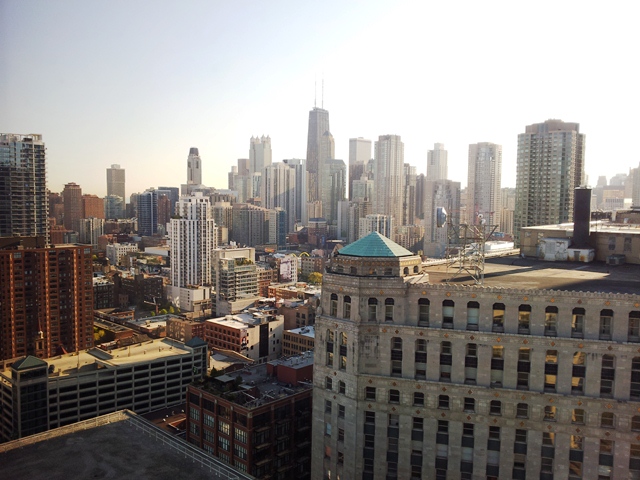
The view from my hotel window on the 22nd floor.

I had never been to the mid-west, other than changing planes at O’Hare once, maybe 15 years ago. (With the exception of a week-long trip to Winnipeg for my best friend’s wedding in 2000. But that’s Canada. Doesn’t count.) And I will be honest, Chicago was not really at the top of my list of new places to go. It just so happens that the company I work for has its U.S. headquarters there, and the company sent me on a business trip. So I went.

As your typical Northeast-Mid-Atlantic-I-95-corridor-sophisticate, I never gave my country’s heartland a second thought. All these years I thought there was just lots of white space and corn fields and cowboys between where DC ended (Georgetown) and the San Francisco Bay Area started (Berkeley). Heck, until five years ago, I had never even been to San Francisco, either. So here I thought there was just 3,000 miles of nothingness between the left and right coasts. I guess I started taking note of Chicago when Barack Obama emerged as a potential presidential candidate in 2007-ish. But I never really felt like I had to go there.

So on my first trip to Chicago, I arrived last Sunday with zero expectations and was open for, you know, whatever. And I was really impressed. The first Chicagoan (or is it Chicagoite?) I met was friendly and  helpful, showing me how to use the ticket machines to buy a fare on the L. The second one I met, as I got on the train, wished me a great time in his fair city.

I called an old friend of mine I hadn’t seen in more than eight years – a native of the South Side who moved back after years away to work as a television producer for a major national network. He drove me up and down Lake Shore Drive, showed me all the sights – at least from afar – and fed me a Chicago deep-dish pizza (basically a cheese quiche with a half-inch of tomato sauce on top) in his neighborhood pizza parlor, as we caught up on each other’s histories.

On day two he took me to the 27th floor of some ritzy downtown hotel and we drank very expensive whiskey and prosecco while gazing out the floor-to-ceiling windows, as twilight fell upon the bustling city below and all around us.

The Loop from high up.

(Yes, I did go to the office, too, and met lots of really nice folks there as well. Mid-westerners, mostly.)

What a great surprise, getting to know this cool city under brilliant springtime sunshine, as well the wind that gives the place it’s nickname. Giving rise to the thought that I’m not sure I’d want to spend a winter there.

And I realized once again that the Dalai Lama is a really smart guy.


Jake sets sail

11 03 2012

A very good friend of mine, let’s call him Jake, will be leaving his family soon on a seven-month journey that will take him to the other side of the planet.

He is doing this not completely voluntarily, because it’s part of his job. Jake is an officer in the U.S. Navy, and his ship is about to depart on a long military deployment.

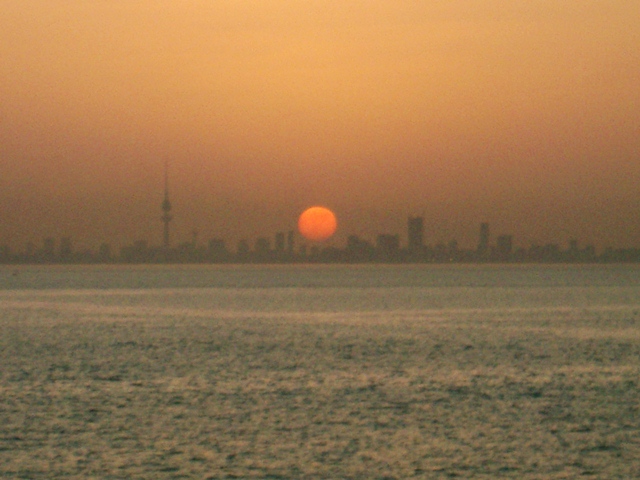
I met Jake almost ten years ago, on a different Navy ship, just off the coast of Kuwait, its iconic city skyline on the horizon on the starboard side. Back then, he was a member of the crew and I was a journalist, and we watched the politics of the region heat up from front-row seats. The ground war in Iraq was a few months away but the conflict had claimed its first lives already.

Kuwaiti sunset, October 8, 2002

Jake and I kept in touch and we became really good friends. I got to know and love his parents, his wife and their two cool daughters, too. We visited each other – I traveled to both coasts of the United States to see them, they came to Europe to see us. They played a very important role at my wedding.

On a hot night in 2003, Jake, living in San Diego at the time, was my last link to the outside world as I sat in the back of an SUV, speeding through the darkness to Iraq from Amman, Jordan. We carried on a conversation by SMS until I got a few kilometers inside the border. Our chatting across 11 time zones ended abruptly as the sun began to rise, and I slipped out from under Jordanian cell phone coverage.

Iraqi sunrise, August 8, 2003

Nine years ago this month, the world saw a superpower and a dictator posturing for the public. The dictator lost on the first night of hellfire in Baghdad. Woe to those who try to tangle with the biggest military might in the world.

The politics of the region are, once again, in turmoil. The names of the places and the actors are different, but the anger behind it is similar. This new (and still verbal) conflict has very sinister undertones – there is talk of nuclear weapons for the first time since the Cold War ended. And Jake and his shipmates are sailing into the thick of it again.

It’s his fourth or fifth multi-month cruise in something like 12 years, and while I do understand his commitment and service to his country, I wonder how much more of this he and his family will be forced to endure. His father passed away recently, and he will miss his oldest daughter’s high school graduation this Spring. Last year she turned 18 without him… because he was underway.

I wish Jake – and the thousands of military personnel he sails with – Godspeed; that they return home physically and psychologically unscathed.  For the families and friends they leave behind, the wait will be a long one.


The THINGS take Switzerland

1 03 2012

A couple of weeks ago, some visitors decided to stop by. The timing wasn’t great because I had just started my new job and am also attending university courses for the first time in 20 years. That double whammy had me going to bed at 9pm every night for the first two weeks because I was simply exhausted.

The THINGS, as they are known, belong to my only good Canadian friend, the lovely and hilarious Ironic Mom. She is sending them around the world in place of her 7-year-old twins. (Though I’m sure that on some days she would have been quite happy to send the twins.) On their Excellent Adventure, which started last summer, they have already criss-crossed the United States and Zurich was the first stop on the European leg of their tour.

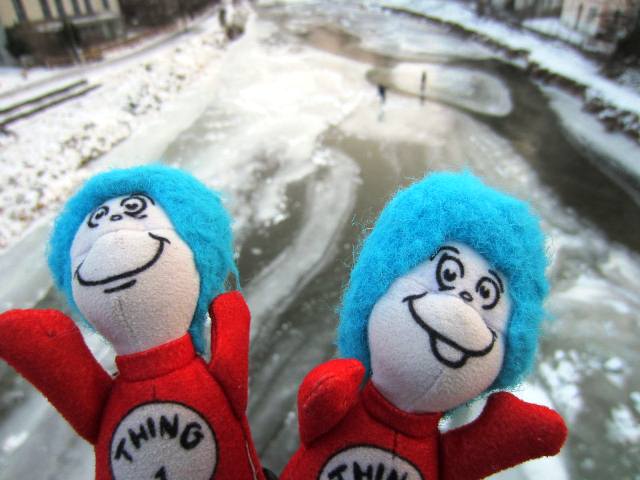
In addition to my new job, we were in the middle of an incredible cold snap, with daytime high temperatures of minus 15 degrees Celsius (3 degrees F for you Fahrenheit types). So flying and rollerblading – my staple activities when the weather cooperates – were simply out of the question. Actually, anything that required leaving a heated building was rather painful and not recommended.

(Maybe they can stop back here in the summer?)

Other hosts have been very creative with their blog entries about the THINGS’ visit – writing in rhymes and singing in harmonies – I’m afraid all I can offer is a few photos of nothing special in the land of cows and chocolate.

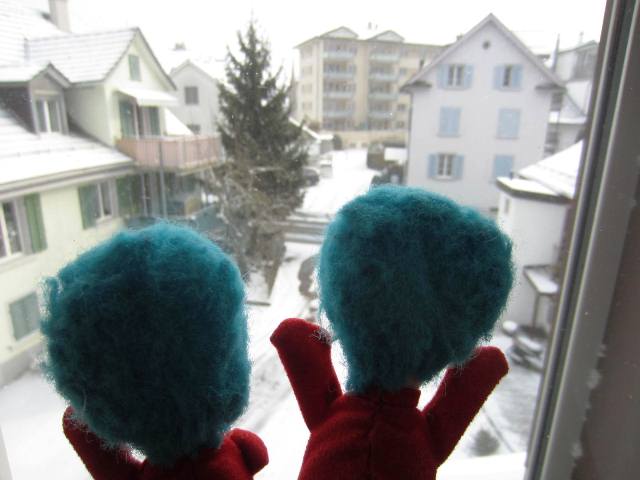
"We’re here!"

"Geez. Looks cold out there."

"SH*T. It IS cold out here."

"Want to go for a hike?" "No thanks, not today."

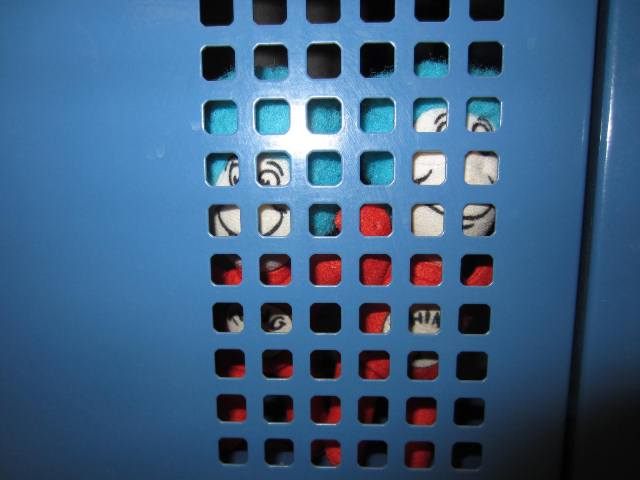
So to escape Switzerland’s harshest winter in three decades (and as a warmer alternative to any outdoor sports activity), we went to the gym. The THINGS hid in my locker until they realized that it was ME that would be working out… that they were just along for the ride.

"Get out of there, you two."

On the rowing machine…

…the bouncy gym ball…

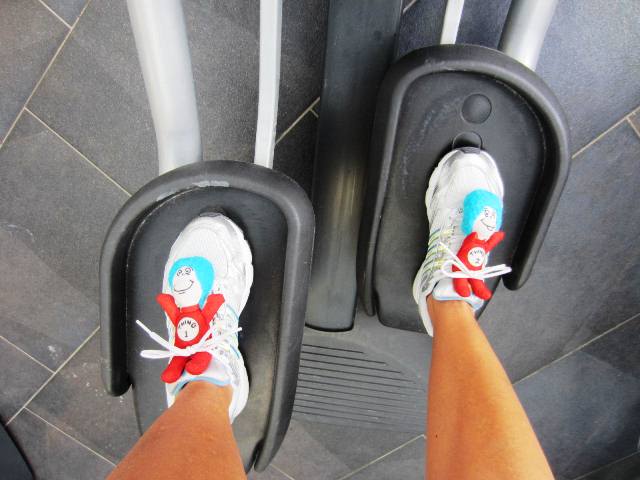
…and the crosstrainer.

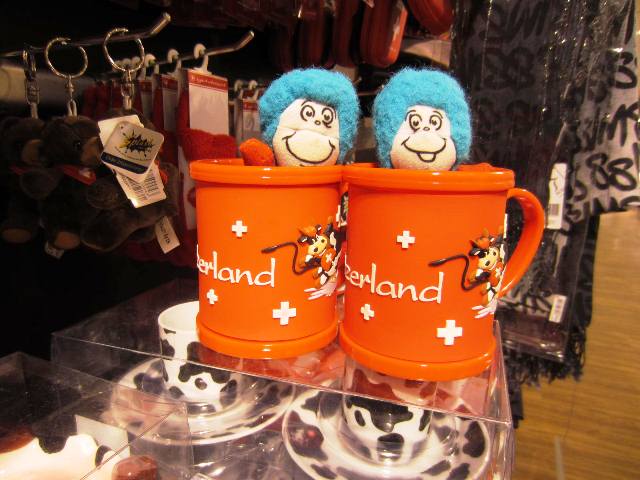
We did venture out into the city one day, and made some more friends (animal and human) in the department store’s extensive Switzerland souvenir department.

"Moo."

… as the salespeople wondered what the hell they were doing climbing into the souvenir kiddie mugs.

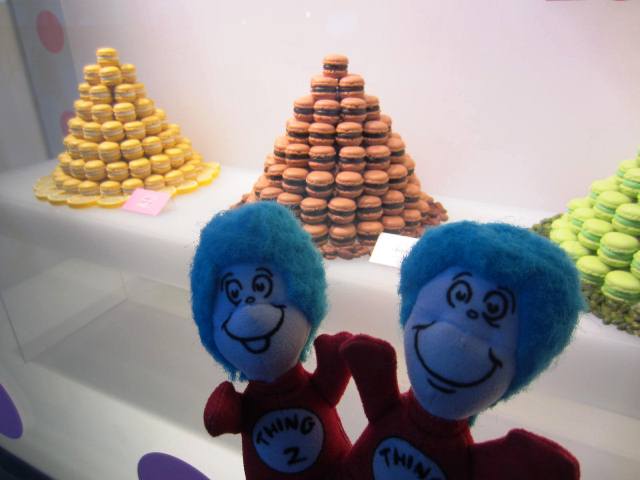
To end their visit we made one last stop, at the world-famous Spruengli chocolate store. After all, what do Swiss people need all those cows for, anyway? Because they are the world’s largest per capita consumers of chocolate!

The THINGS knew this, but had to wait till their final day here to partake in the experience.

"Yum, look at all those chocolate cakes..."

"...and the pyramids of macaroons."

The THINGS got enough of the “food of the Gods” to last them till they arrive at the next stop on their world tour. (Trust me.) They are off to the UK next, where I’m hoping Spring has sprung and they get to spend more time outdoors. Watch for further installments of their Excellent Adventure on www.ironicmom.com.

Meantime… I have to get back to my new job.

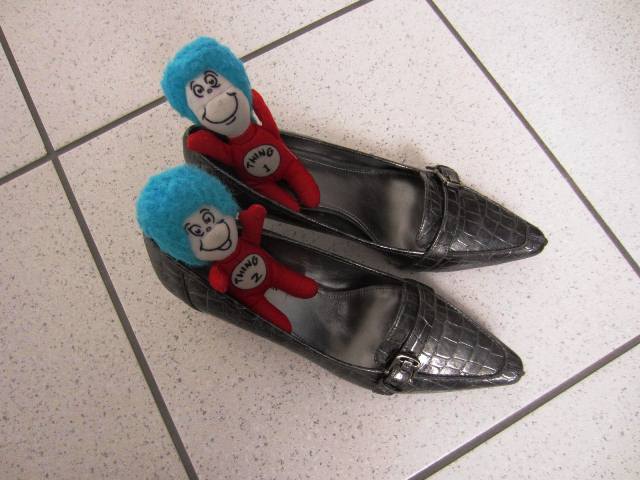
Shoes definitely NOT made for walking.