Seeing “home” through a different lens

5 07 2012

It was Independence Day this week, the day when all red-blooded ‘Mericans – at home and abroad – celebrate with fireworks and barbecues and the red-white-and-blue. On July 4th 236 years ago a bunch of smart guys in wigs and knickerbockers told the Brits to go stuff it, and founded their own country.
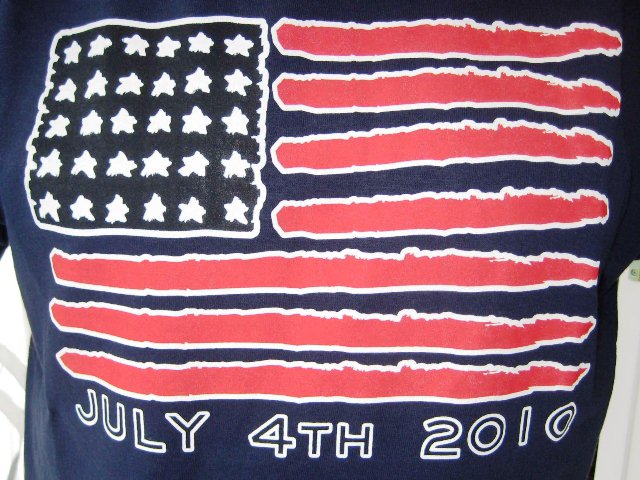
Recycled t-shirt.

I am also one of those who celebrated with a slab of seared beef and a fine bottle of California Cabernet Sauvignon. But I live overseas. No fireworks show on TV or outside my window, not even a sparkler within reach. But that makes me no less American. The U.S. is my home, Europe is where I am currently living.

Why? It just kind of happened that way. I finished my Master’s degree in 1992, just as the first George Bush was wreaking havoc on the economy. I couldn’t find a job at home so I took off and found a career elsewhere. But I have every intention of returning someday.

So for the past 20 years I have observed life in America from across the pond, sometimes with amusement and sometimes with disillusionment. Sometimes with envy and sometimes with sadness. Often, I wonder just how much it has changed in these years I have lived abroad, and if I will ever feel at home there again.

An squabble on Facebook overnight prompted me to think about this once again, intensely. A FB friend of mine, surely blinded by the sudden rediscovered patriotism that hits every American squarely in the gut as s/he watches fireworks over the Washington Mall and hears emotional renditions of the Star Spangled Banner, posted this comment:

Watching the DC July 4 show on TV. Every year it overwhelms me. I am honored and proud to be an American. Can someone explain to me why we are now trying to become Europe? We have fought long and hard for the freedoms and privileges of this beautiful, free country!

A wise woman friend of hers responded a short time later:

I don’t think I follow you. I think we’re just trying to secure an equal opportunity for a happy and healthy future for ALL our citizens, not just the wealthy ones.

It was July 5th by the time I saw these and added my own two cents:

Not quite following either… Last time I looked, Europe was also beautiful and free… Wouldn’t be living here if it wasn’t!

Upon which I got this slap in the face from the original poster:

The economics don’t work. And the resulting entitlement is disastrous. My immigrant grandparents would be disappointed.

And I’m thinking … “Lady, have you ever even been to Europe? Do you even know what the hell you are talking about? Could you locate Europe on a map? And your immigrant grandparents – they probably had really good reasons for leaving Europe during the Second World War… sooooo… what’s your point, exactly?”

This same FB friend already reproached me last week for celebrating the Supreme Court decision on Obamacare, writing something to the effect of: “Those of us who have to pay aren’t happy about this at all.”

Of course, this could just be a single slanted opinion from a single self-centered person. But I get the sneaky feeling that there are a whole bunch of folks in the U.S. who think this way.

So I am asking myself today – what happened to the solidarity and the kindness and the helpful, open, optimistic and accepting attitude I always remember Americans by? What happened to the mutual support, the looking out for one another, the spontaneous neighborliness and the caring for strangers that I remember from growing up in a small community in the Northeast? What happened to them? Where did they go?

Maybe I just need to de-friend this person on FB. But when I finally do find a way to live and exist in the United States again, with some kind of financial security, when I find a job I can live off of, with guaranteed health insurance and a pension that I will work hard for, that will still be there when I retire, whenever and wherever that may be: is this the kind of selfishness and ignorance I’m going to have to deal with? Is everyone like this? Will I even recognize this place anymore? This place I’ve always called “home”?


Gigathlon 2012 by the numbers

2 07 2012

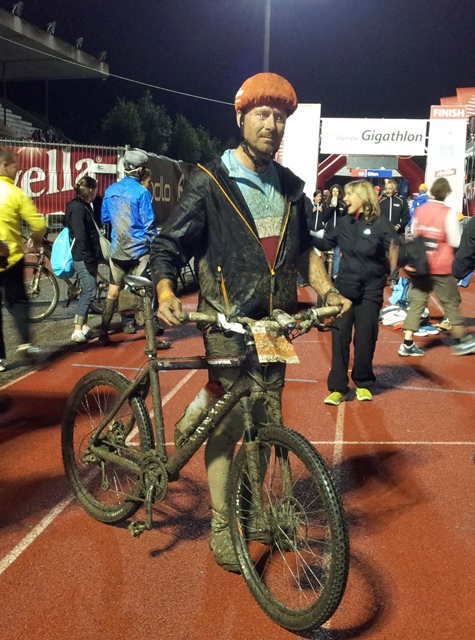
Our mountain-biker said it best, just after he crossed the finish line covered from head to toe in mud: “All you have to do is shut off your brain.”

Of course, he was talking about the biking leg of Gigathlon 2012, this past weekend’s athletic extravaganza in the Swiss midlands, and about how torrential downpours and impending darkness turned his route into a rather messy and slippery lottery.

Our mud-splattered mountain-biking hero after crossing the finish line.

(The second part of the sentence was: “Let go of the brakes, point the bike downhill and hope there is no tree in front of you.” Our swimmer responded: “That bit about the brain – that’s the crucial difference between men and women.”)

But what he said really was valid for all of us who made up the “Flying Five,” a rag-tag group of over-39 amateurs, tossed together by fate, self-discipline and the ambition to overcome physical and psychological limits. Our goal: to swim, cycle, skate, mountain-bike and run to the point of exhaustion, to complete the two-day endurance race 1) uninjured and 2) within the allotted time frame.

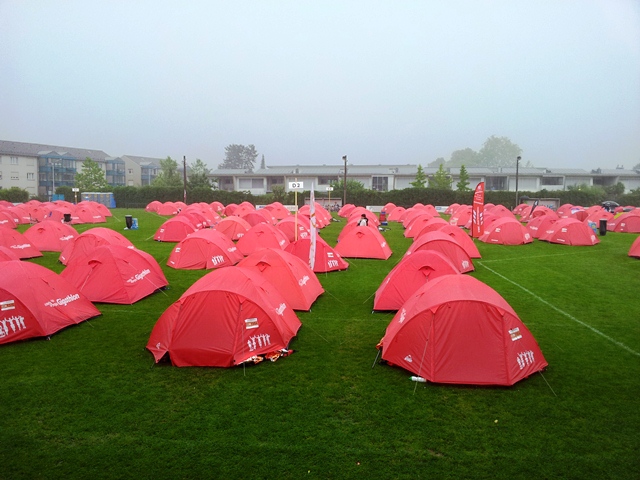
And we did both, crossing the finish line together at 11pm on Sunday evening, 40 1/2 hours after the starters’ gun went off. We had spent two days competing in extreme weather conditions – day one was hot and humid, day two blessed us with fog, rain and hail – and sleeping in a tent whipped by one of Switzerland’s most destructive overnight thunderstorms in years.

There were many times in the past couple of days when we all just shut off our brains.

Sunday morning, 730am: wet, wet, wet.

You read about my preparation for this year’s race a few weeks ago, and now I could give you a play-by-play like I did last year, with the highlights and low-lights, the dramatic moments of pain and agony and the equally dramatic moments of indescribable adrenaline-induced euphoria. Gigathlon 2012 had all that too, trust me. But this time I will just stick to the numbers; they also tell the story of our exceptionally active, life-affirming weekend.

First the team:

Hours, minutes and seconds the five of us were underway in competition:  30:27:37

Hours, minutes and seconds the winning team beat us by: 11:24:00

Rank at the end of day one (out of 1,000 “teams of five”): 756

Final rank after two days of competition: 723

Distance skated, swam, mountain-biked, run and cycled: 460km/287.5mi

Temperature on Saturday: 34 C/93.2 F

Thunderstorms experienced on Sunday: 3

Beers consumed on Saturday: 2

Beers consumed on Sunday: 8

Accidents: 0

And I know you people also want to hear about my personal statistics for the weekend, so here goes:

Distance skated: 92km/57.5mi

Hours slept on the campground (two nights): 6

Times I felt like quitting on Saturday: 4

Times I felt like quitting on Sunday: 0

Ball bearings trashed: 16

Accidents witnessed: 5

Pasta meals consumed: 3

Sports energy gel tubes consumed while skating: 3

Blisters: 4

Toenails lost: 1

Hours slept after getting home (one night): 11

**********************

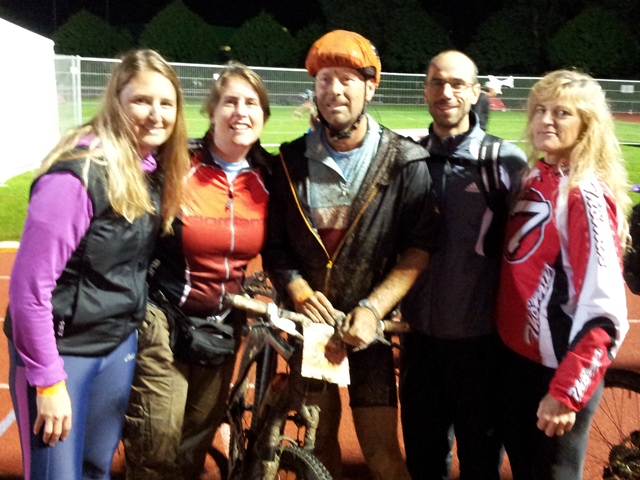
Team Flying Five….. before…..

…. and after.

A HUGE, HUGE thank you to: Martina – our team captain and tough-as-nails cyclist, Raphaela – our running goddess, Beat – our meerkat-like mountain-biker, and Reto – our swimmer who rescued the team’s ranking on both days. You guys were a whole lot of fun to be around, even when the things got really, really tough. You were the reason I kept on going.

(Anyone up for Gigathlon 2013?)


Sir Bob rocks my world

7 06 2012

As a 42-year-old, there is not much that rocks my world anymore. I have seen quite a lot of it and become rather cynical about many things. But this week, my world was definitely rocked.

How often do you get the opportunity to meet a childhood hero? Okay, as a journalist I had more of an opportunity than most to experience powerful politicians, sports figures and movie stars, for example, in action, live, with my own eyes, in front of the lens of my camera.

But yesterday, I encountered someone whom I have looked up to and admired from afar for almost 27 years. That’s two thirds of my life.

Do you remember where you were on July 13th, 1985?

On July 13th, 1985, I was a teenager, and I woke up to a glorious summer Saturday in Vineland, New Jersey – about 30 miles south of Philadelphia – on which I would play in my first (and, it would turn out, my last) tennis tournament. I was swiftly smoked off the court, 6-0, 6-0. My mother had scheduled a yard sale; we were about move house yet again and she was on a mission to clear out useless clutter from our garage, our closets and our lives.

But something else happened that day… not too far away, in fact, just down the road in Philadelphia. Something that had global reach and global consequences.

Do you remember Bob Geldof? (Now “Sir Bob” to us mortals.) The guy who rallied his musician friends and family to fight poverty, drought and famine in Africa. His “Do they know it’s Christmas” LP was the very first piece of vinyl I purchased with my own money. Same guy who organized simultaneous blockbuster charity concerts in Philly and London on July 13th, 1985: Live Aid.

Remember?

I met Sir Bob Geldof yesterday, live and up close.

Almost 30 years on, he is now over 60, looking a little the worse for wear, but still rallying the masses with personal, passionate, inspirational messages, delivered extemporaneously, and unconventionally. A scandal here and a bit of outrage there always accompanied him on his journey.

But that never stopped him from his goal of changing the world, a single opinion at a time. With much noise, and little subtlety.

Last night he spoke to an international group of 200 high-level corporate executives from the chocolate industry, government officials and NGO representatives at a five-star Swiss mountain resort. At the industry’s invitation, he spoke about its responsibility to the regions of Africa, Asia and South America from which it sources its cocoa, and where its farmers eek out a precarious existence at the mercy of the weather and the global terminal markets. He spoke about deprivation and dependence, the need for ecological as well as social sustainability for communities ravaged by natural and man-made disasters, AIDS and hopelessness. He spoke about taboo topics like human trafficking, child labor, deforestation, abject poverty and exploitation.

He held up a mirror to the industry, and told all of those important folks in the room exactly what he thought of it. While he acknowledged that all of us are, generally, good people (probably), there are a lot of things our companies continue to do that are absolutely disgraceful. And that in the future, something must change.

We always blame it on “the system” when really, “the system” is every individual.

And the future, well, the future is now.

Geldof was in fine form, using the F-word a good dozen times in 45 minutes. I sat in the cheap seats and enjoyed every minute.

After his speech and a photo op, the event’s organizers invited him to join them for dinner. He declined, adding: “I just want to go get drunk now.”

Just a regular Irishman.

Rock on, Sir Bob. You are my hero.


White folks, a school and recess.

20 05 2012

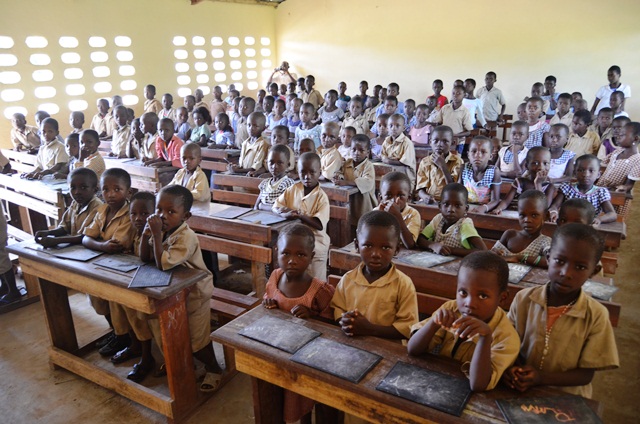
One hundred pairs of wide brown eyes stared at us like we had just landed in their corner of Ivory Coast from the moon: Two women with pale skin, smiling.

The classroom.

These two strange-looking women were accompanied by a third woman, carrying a leather handbag, who looked like they themselves did, or rather like their mothers, just better dressed. And better fed.

We felt a bit like we were in a zoo: the grown-ups showed us what was there, in the classroom, and the hundred kids got to take a good long look at what had just walked in the door.

The question was only – which of us was the caged animal?

Perhaps they had seen white people like us before, but likely only men, and only in a position of power. A foreman on a rubber plantation where their parents worked as day-labor, or a buyer for the cocoa that their parents harvested on their smallholder farm. In both cases the white man determined what they would eat, and if they could afford to go to school, or to a doctor. Today or tomorrow. Or never.

The principal of the rural primary school about 150 kilometers east of Abidjan opened his doors wide for the visitors from far-away Europe. The children stood for us, bade us good morning in unison, and then sang for us. And they stared at us. It was a strange feeling, being greeted like royalty, or the President.

A goat munched serenely on weeds near the flagpole. A natural lawnmower today, lunch (if necessary) tomorrow.

The schoolyard (with goat and woman).

The school has three classrooms for the 180 kids currently enrolled, a small office for the principal, housing for the teachers – including solar cells on the roof for electricity – and a water well in the barren schoolyard.

The youngest kids looked to be about 6 or 7 – the age where most children in most countries start school. But the one or the other stood much taller than her comrades. A teacher told us later that these were the kids who lived farthest away, and whose parents didn’t let them begin first grade until they were 10 or 11.

Some kids, the principal said, just do not show up during the harvest of whatever crop their parents or neighbors farm. Other children attend for a year, but don’t come back when the new term starts. The teachers are used to this, and have no choice but to accept it as part of this traditional, agricultural society, where child labor (and child slavery) is not uncommon. Often the parents are illiterate, and don’t know better.

During our visit, the principal promised the kids that if they are really good students, and work very, very hard, then someday they can get on a big airplane and fly to where these two strange-looking women came from.

The older kids laughed, knowing full well this was something that maybe a single lucky one of them might experience in a lifetime. The younger ones seemed more bewildered than anything else. They didn’t seem to find this funny – or a state to which they would really wish to aspire. An uncomfortable, confused silence followed. We kept the smiles pasted on our faces so that we didn’t have to say anything – because we had no words at that moment.

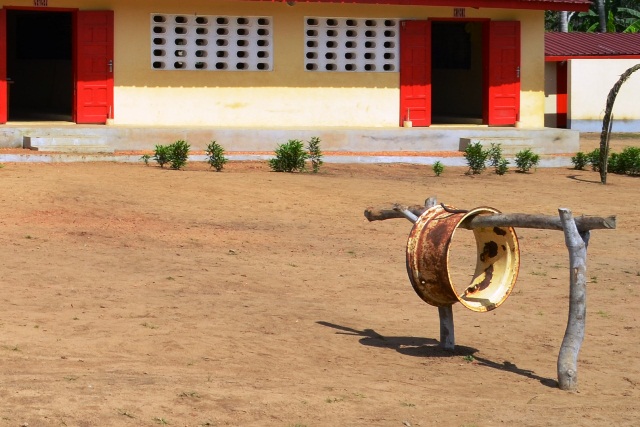
At mid-morning a small child ran out of one classroom, grabbed a stick and banged on the rim of an old truck tire that had been stripped of its rubber, hanging on a wooden frame in the middle of the schoolyard.

The bell.

And then we saw what happens at recess at probably every rural primary school in Cote d’Ivoire. And all over the world.

180 kids + break-time = boundless energy.


Three women of Africa

11 05 2012

The first woman is cocoa farmer, grasping a rare opportunity to learn.

On this overcast day she joins two dozen men of her community in an educational program that promises to help her grow more cocoa pods, and deliver higher-quality beans that will be used for exclusive foreign chocolate and enjoyed in sophisticated European capitals that she will never see. She hopes to apply the things she learns on her own farm, to generate a higher income, and build a better life. She squats on the ground in her flip-flops and mixes a pile of freshly shucked cocoa beans, up to her elbows in the white pulp that tastes a little like lychee juice.

She sings while she works.

Womens’ work.

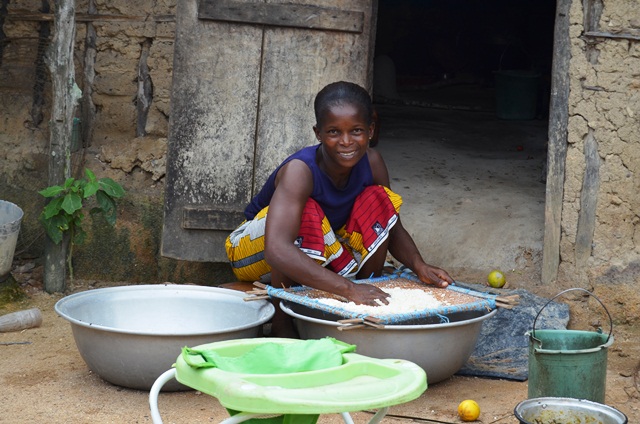
The second woman is a villager, grinding manioc on the doorstep of her mud-and-wattle home, to feed her family.

Her settlement is in a clearing in the rainforest, a red dirt piste the only connection to the main road, several miles away. To get there, we drive slalom around potholes wide enough to easily throw out an axle, and deep enough to easily swallow an entire car. These homes have no running water or electricity, and the roofs are made of dried palm leaves.

She tastes some of the chocolate we bring from far-away Europe. It is soft and runny, from the heat, but she takes a handful anyway, and sucks it off her fingers.

Womens’ work.

The third woman is not a woman at all. She is a child of maybe 13 or 15 years old, who has, herself, just borne a child, a few hours earlier. He lies next to her on the plastic-covered bed, stretching his arms skyward, to hug his new world, while she rests. The doctor at the rural health center tells us that the birth took place without anesthesia. “Natural childbirth,” they call it here. To get to the clinic at the top of the hill she had to walk. Her own mother, barely 30, accompanied her. She is now a grandmother.

I did not photograph them.

**********

These are three of the women I met last week in Ivory Coast, a country of 21 million inhabitants nestled between Liberia and Ghana in Western Africa. “Met” is perhaps an exaggeration. I don’t know much more about these women than the basic facts I have written down here, hastily scribbled into my reporters’ notebook at the time. I don’t even know their names. We exchanged a handshake, a “Bonjour madame!”, a smile, and a laugh at something silly. Our worlds touched briefly, with that bond dispersing a short time later, just as quickly.

These are three of the strong women of Africa.

She is the backbone of her community, she is the keeper of her family. Here in the rural communities of the Ivory Coast, she learns from an early age that she must embrace hard physical work to survive. And that she must endure the constant machismo of a traditional male-dominated society, where polygamy is regularly practiced and inheritance usually only passes to her brothers. She bears these lifelong hardships with dignity.

Every day she has a million miles to go before she can sleep.

This was my first visit to Western Africa, and it will surely not be my last. My body returned to Europe this morning. My soul is having a hard time keeping up.

Womens’ work.