Swiss summer fun

28 07 2010

Summer brings everyone outdoors. It’s warm, beautiful and the days are long. But nowhere does summer entice the population to spend its time outdoors more than in Switzerland. The Swiss have perfected the art of being perfect – clean water, clean air and pristine landscapes – and as soon as it starts to smell and feel like summer outside, the Swiss are off gallivanting through their own personal playground: the Alps.

Now there are about a million crazy things you can do in the summer with the Alps as your backyard (and another million in the winter). I had never heard of most of these so-called “high risk sports” till I arrived here six years ago. Oh sure, usually harmless pastimes like hiking and mountain-biking are popular here, too, but please – only if the path hugging the side of the mountain has a 40% grade, is less than a foot wide and drops off into a deep ravine on one side.

Here’s a short list of stuff I’ve discovered that looks cool, is cool and inevitably ends up claiming a couple of lives every summer. The activities all involve moving vertically somehow, usually from higher ground to lower ground, in a more or less controlled fashion. A good reminder that gravity is a law and not an option.

Base Jumping – This is the craziest of all and the one that is probably responsible for the most casualties. Definition: Jumping from fixed objects. B=building, A=antenna (or tower), S=span (i.e. a bridge), E=earth (i.e. a mountain edge). You freefall and pull the chute just before going splat.
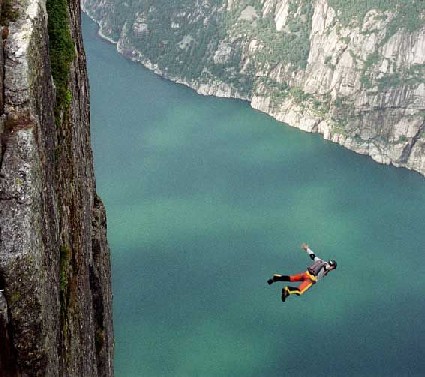
Look ma, no parachute!

Canyoning (known as canyoneering in the U.S.) entails hiking up a mountain and then traveling through its canyons using a variety of techniques that may include other outdoor activities such as walking, scrambling, climbing, jumping, abseiling, and/or swimming. I’ve done this and it’s incredibly fun. Canyoning combines agility, strength and a healthy love of heights – on land, in the air and in the water. Often though, there is only one way out – down. Some important safety information, found on the internet: “There is great potential for injury for the unlucky, the reckless or ill-prepared.”

Paragliding – Jumping off a mountain with a kind of sophisticated parachute (called a “paraglider”) open already. On a pleasant day, paragliders can fly for hours with only the thermal lift to carry them. Their colorful chutes often dot the summer sky across Switzerland and sometimes pose a hazard to low-flying aircraft. Getting one tangled in your propeller can be messy.
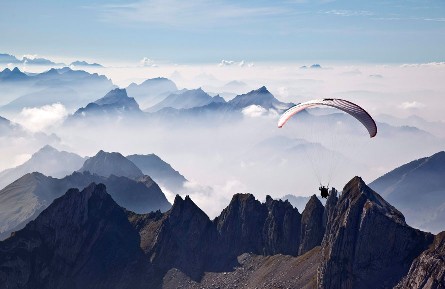
Spectacular view

Tobogganing – This is the summer version of the luge in winter. You sit in a plastic or metal tub and careen down a mountain in a metal canal. If you use the brakes you’re a sissy.

Via ferrata – Italian for “iron road” – a form of rock climbing that sends you on a mountain route equipped with fixed wire cables and artificial hand- and footholds. It allows non-climbers to try real mountaineering. One website reminds potential athletes that in order to actually enjoy your outing, you need to be “fearless”.

Rock climbing for beginners

Summer adventure, anyone?


The need for speed

22 07 2010

It’s about time I wrote something about one of my passions in life.

I am an avid and obsessed inline skater.

You may be more familiar with this sport under its colloquial name: “rollerblading”. It continues to be associated with the brand that first began to make and sell this particular kind of skate in the 1980’s. Today, Rollerblade is one of dozens of skate manufacturers but the misnomer has stuck. I have never skated Rollerblade. Today I skate K2.

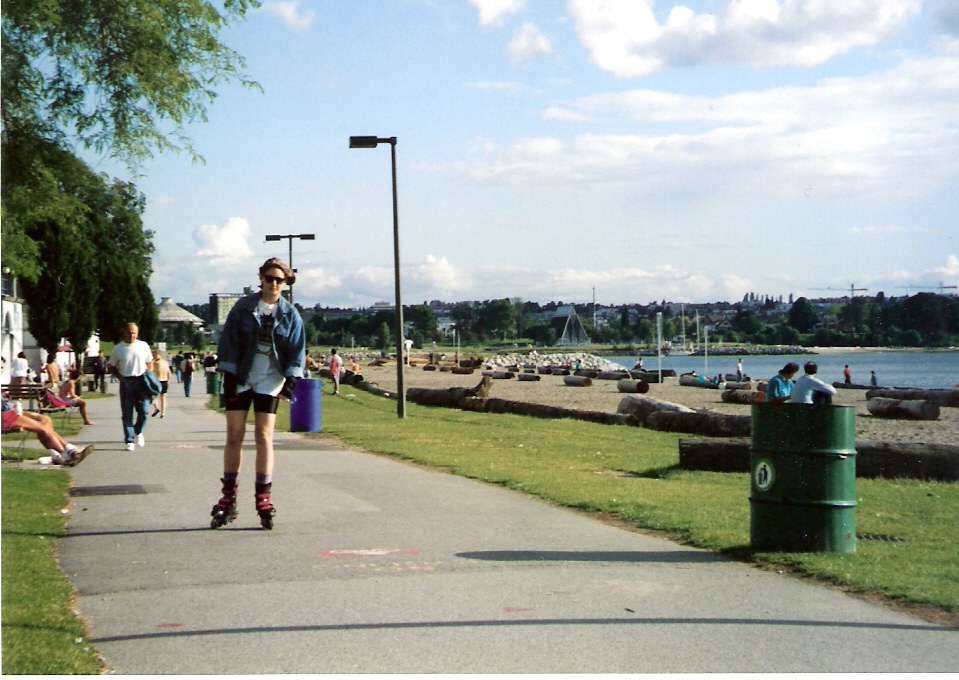
I first put on a pair of inline skates in July 1993, near Vancouver’s spectacular Stanley Park. Everyone was doing it, it looked so easy, I figured I’d get the hang of it in a snap and be cruising on the Seawall in no time. Radiating naiveté, I took my first tentative steps in what felt like ski-boots on wheels. An amused crowd savored the free entertainment from the sidelines.

Evelynn skates, Vancouver, 1993

As in all endeavors in life, you only need to get up one more time than you fall down. And hell, I fell down a lot that afternoon. The crowd roared. And I kept getting up again.

Taking up skating was one of the best decisions of my life. I’ve discovered that it’s the closest you get to flying without ever leaving the ground;  a full-body aerobic workout without pounding pavement. And it’s a way to simply feel free. During the summer months, I try to knock off a cool 20 km or more every other day, weather-permitting.

About ten years ago I started to race and my competitive skating credentials now include everything from 10 km sprints to full marathons. I know I will probably never actually WIN anything, ever, but the thrill of the chase and the chance to push myself to my physical and psychological limits are what keep me coming back for more. It’s the speed that is particularly intoxicating.

My injury list is mostly harmless – scrapes, shredded skin, bruises and strained joints. Lesson number one was learned early: the street usually wins whatever fight you try to pick with it. There’s been the one or the other collapse due to exhaustion. And I’ve only had to be whisked away by ambulance once – with a season-ending triple compound fracture that required two surgeries, a titanium plate and seven screws to fix. (You should have seen the other guy… yeah, he was fine.)

This year, barring anything serious, I will hopefully peak on the final weekend in September at the Berlin Marathon – a European classic, and one of the five World Marathon Majors. In addition to the 40,000 ascetic sadomasochists who sign up to actually run the 42.195 kilometers through Germany’s capital, about 9,000 slightly more sane skaters also have the opportunity to compete. Our motivation? Fame, fortune, bananas and free beer at the finish line.

Evelynn's skate, Berlin, 2008

It will be my sixth full marathon in Berlin, a city that embraces athletes from wherever they hail and puts on a great show. I have simply not found a better-organized, cooler race, or more appreciative and enthusiastic spectators, anywhere.

As an over-40 amateur, I can only dream of reaching the finish in under an hour and a half.  The professional (female) athletes, 20 years younger than me, complete the circuit in about an hour and 15 minutes. My goal this year is a pretty respectable 1:45:00. In 2008 I came close, missing that mark by a mere 2 minutes. (Or, if you would rather have an even more heartbreaking statistic: 3.5 seconds per kilometer.) The days of a personal best (1:42:32) are probably over – I was still a spring chicken thirty-something the last time I set one of those. But, you know, impossible is nothing, right?

65 days to go. I’ll keep you posted.