The sad state of inline skating in the USA

1 04 2011

Coming to the land of new innovative sports and the birthplace of inline skating, I thought I would arrive in an El Dorado for rollerbladers, the likes of which I will have never seen before. Especially in Florida, where the weather is conducive to outdoor sports pretty much the whole year round.

Sadly, that is not the case.

Before I arrived here in Florida, I found a group on the Internet that conducts a weekly night skate. I was ecstatic. I imagined hundreds if not thousands of skaters, collectively taking back the streets, just like they do in every European capital at least once per summer month. (Think: Skaterparties in Paris, Berlin, London…) Even in Zurich our Monday Night Skate attracts anything from 2000-6000 participants every second Monday from May to September.

The Wednesday night gang.

The first time I joined the skate group here in Hollywood, I found eight people waiting at the assigned meeting point. And I asked… “Is this the skate group? This is it?” One of the other skaters answered, “Oh, this is a great turnout.” Last night’s group was 14 strong, a real army.

This is how I discovered that the skater demographic here is um… small and not really, shall we say… sustainable.

The folks I met in the group and also when I’m out skating on my own are great – very friendly and chatty people, we have a grand time. But they are all… well… middle-aged. There are Tom and Dave, who are in their late 40s probably; Karen is a few years younger. Then there’s Harry, who I would have guessed is in his late 40s but is actually 62 (a true testament to the youthful effect of skating). Those are a couple of the regulars. I have never seen anyone at the meetings that was under, say, 35.

Then there’s also George, who looks like he’s 70, but is probably 85. He is out every morning at 7:00 a.m., skating his laps along the beach like there’s no tomorrow.

They all complained to me that for some reason young people are not interested in the sport. And even though the group officially has more than 370 members (according to their website), only a fraction of those show up for the weekly meetings. Kids don’t seem to find skating “cool” anymore.

There is no decent skate shop in a 100 mile radius and I know of no organized races within a day’s drive.

George told me that for a few years, Disney organized an annual skate marathon in Orlando, but declining participant numbers prompted them to cancel it. Unfathomable for us in Europe, like the folks at the Berlin Marathon, who have to turn away hundreds of skaters every year because the event is sold out six months before the race.

My skate friends here say that for the monthly Miami South Beach Friday night skate (the epitome of coolness if there ever was one) usually about 50 skaters show up. If the weather is good, maybe five more will come. That event is tomorrow night, and I can’t wait to cruise through the Art Deco streets, escorted by police, past curious onlookers and irate motorists. I’m sure it will be a blast.

And I will be wondering where the thousands of other skaters, who would make it truly an experience of a lifetime, are hiding. They must be out there somewhere.

South Beach at sunset.



Just another Saturday night

23 03 2011

A cacophony of voices, a throng of people of all ages, all shapes and sizes, black, white and brown, mingle on the beach promenade. The stroll, skate, sit, eat, talk, run and bike away the lazy day.

I spread my towel on the beach facing the water, take off my sandals and let the clean beige sand slip through my toes. The wind comes out of the Northeast, and the late afternoon sun warms my back. My shadow gets longer and longer as the sun sinks westward, behind the beachfront restaurants, the intracoastal waterway, the Everglades, and the earth beyond. I take out my journal, and write down what I see around me.

Watching my shadow.

To my left, four generations of an extended family chatter away in Spanish. All at once and without punctuation or paragraphs. Some of them sit on blankets in the sand, others on coolers, a colorful umbrella angled away from me is their shelter. Turning right, I see some teenagers play 3-a-side soccer in the sand while, other, smaller kids watch as ice cream from their too-large cones drips off their faces, and between their fingers.

A disembodied orange flag in the ocean mysteriously creeps closer to shore, snaking around to the right. Only as the flag, floating on a buoy, approaches the shallow water do I notice the scuba diver, dressed in black neoprene, attached to it by a cord. He emerges from the waves, takes off his over-long flippers, gathers up his flag-buoy and walks out of the ocean. He looks around at his surroundings as if he was a Martian, just landed on earth.

In my line of vision to the open sea, a small girl sits in a hole in the sand that it probably took her all day to dig with her tiny white plastic shovel. Her head is the only part of her body still sticking out above ground. The incoming tide inches ever closer to her construction site. And just a few minutes after her mother calls to tell her it’s time to go home, her hole is inundated with water, the waves rolling in like last week’s Japanese tsunami.

Beyond the beach, a triathlete swims parallel to the shoreline, his labored strokes witness to the fact that he’s probably got a few miles in those arms already today. But he soliders on, bobbing up and down with the surf, moving slowly and steadily from right to left. After a few minutes he disappears to the north, continuing on his way.

Miles off shore, huge cruise ships – cities on the water – march steadily out of Port Everglades in the opposite direction, one after the other, heading towards Caribbean points south, unknown.

On the beach promenade behind me, Tony the Pizza Chef serves up his pies the size of hors d’oevres platters to a hungry clientele. Still, eyes grow wider yet when they see dinner arrive at their tables.

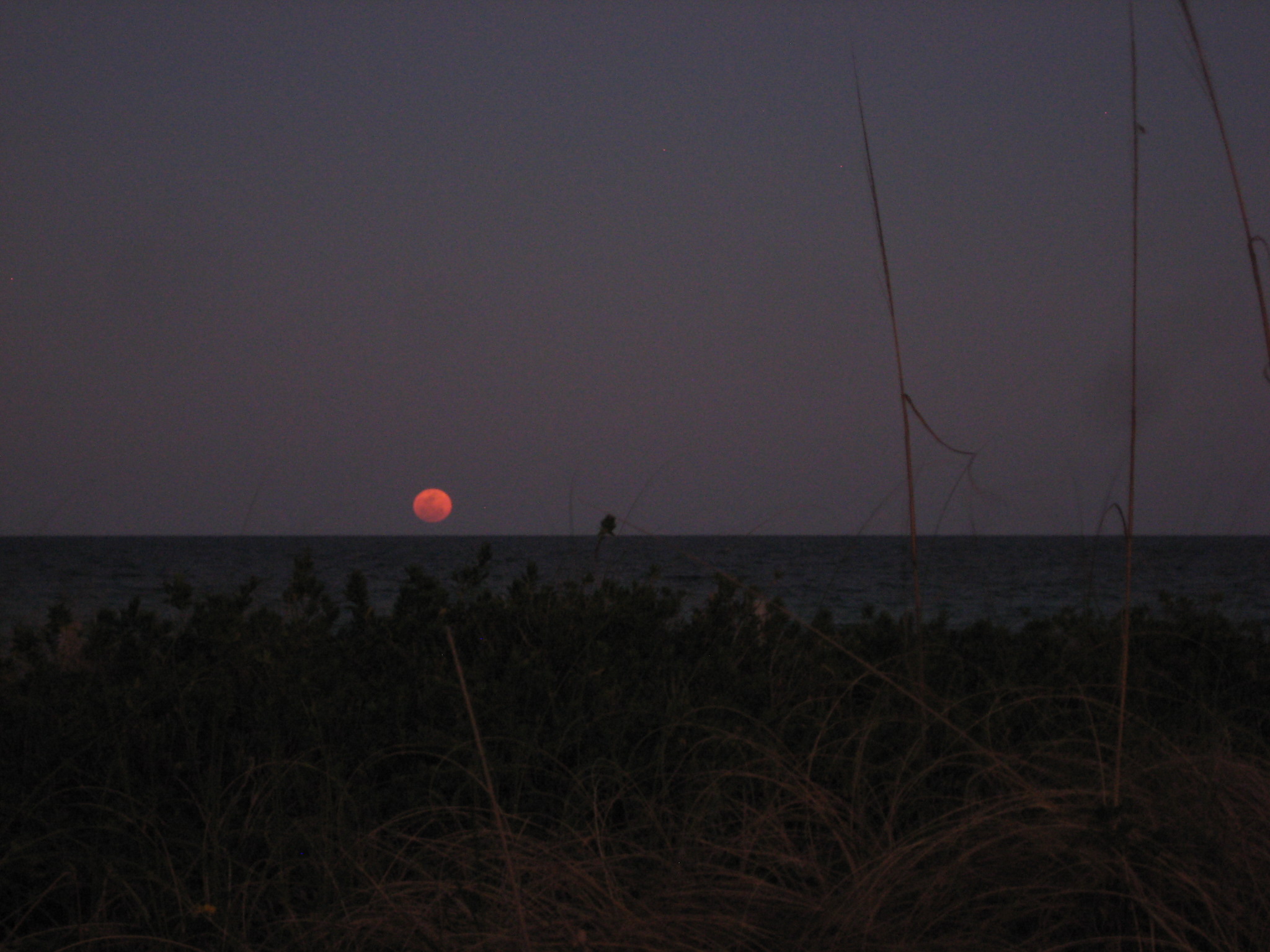
As dusk falls, the blood-red, radiant supermoon surfaces in the distance. Cheers go up, cell phone cameras are aimed and thousands of underexposed, shaky photos are shot, filed, emailed, messaged, uploaded.

An honest attempt with a compact camera.

A rock band strikes up the first chords of its evening set in the bandshell. People dance, tap their feet, embrace life.

On just another Saturday night at the beach.


Daily devotions on eight wheels

14 03 2011

One of my goals on this three month vacation unpaid personal leave of absence is to get a head start on inline skate training for the 2011 race season ahead of my European friends. While they are still shoveling snow and enduring blasts of arctic weather, I get to bask in Florida’s springtime. It’s dry and warm almost every morning when I head to the coast at 6:30 a.m. for my sunrise skate. It’s my personal devotion to the dawn of a new day.

Meantime, my skates are wondering what the hell is going on. In the first two weeks of my stay here I have put in about 100 miles (160 km) or so, probably more than I would do in any given summer month in Switzerland.

Giving the skates a rest at the beach.

But I’ve found out that skating on the beach or along the intracoastal waterway here in South Florida can also be mighty tricky, with many unfamiliar obstacles and sights to see.

First of all, there is the wind. The coastline skate path is, pretty much, due north to south. So when the wind comes from the north or the south, it’s logical that when you skate the one way (into the wind) you are basically standing still. Every yard (meter) forward is unbelievably hard work. And then when you turn around to go back the other way (away from the wind) you are doing nothing less than flying. OUT OF THE WAY, EVERYONE!!

It’s when the wind comes right off the ocean, from the east, that it socks you in the head BOTH ways. Florida has these winds coming off the water probably, oh, I will say, 90 percent of the time.

Second, the sand. It’s everywhere. I don’t even want to venture a look into my ball bearings after these first two weeks. Before I leave here in June, I will owe those babies a serious professional cleaning job. Hopefully they will bear with me that long.

And third, the flora and fauna one encounters in the tropics as opposed to in the old world is so… interesting. In Switzerland, I skate past farms and quaint villages with half-timbered houses that are probably 700 years old. The cattle and horses in the meadows, happily and lazily munching on luscious green, protein-rich grass, lift their heads as I pass. Last Spring on one of my favorite routes near Zurich, I skated by one cow in the process of giving birth to a calf.

Here, I skate past all sorts of crazy-looking palm trees, nouveau-riche waterside villas barely as old as I am and… manatees.

Sea-cows are watching.

Given the choice, though, considering the time of year, I will gladly take the wind, sand and manatees. When hurricane season starts, I will reassess.


Challenges of the English language

10 03 2011

The other twilight I decided to wade into the darkness over South Florida and try a night flight through some of the busiest airspace in the world. But I discovered quickly that darkness is relative. Though the sun dropped behind the Everglades as it does every day, the southeastern tip of the country is far from dark. A sea of light illuminating the ground beneath our Cessna Skyhawk (as well as the clouds above it) was burning enough energy to power a small developing country. For a year or maybe two.

The lights end abruptly in a straight line though, north to south, and the black abyss of the Atlantic Ocean takes over.

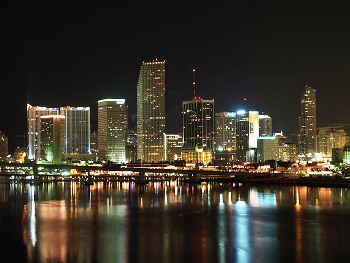
Downtown Miami at night. Gorgeous, isnt it?

One of the great challenges of flying (day or night) in my home country is, I’ve discovered, that I have to actually relearn my own native language in order to figure out what’s going on on the aviation transmission frequencies.

You see, in Europe, where almost everyone speaks English as their first, second, third or fourth foreign language, the pace on the radio is slower and more deliberate. The directions given by the the air traffic controllers have a distinctly European flavor. (And still, I feel sooooo superior with my native English language skills and the “Level Six – English proficient” notation on my pilots’ license.)

But here in the land of the free and the home of the verbally challenged, I am quite simply, erm… a bit lost. That evening when I contacted what is called “Clearance” at my home airport, I gave them my call sign – N5213R – and my intentions – “shoreline south” – this is what I heard back:

“Five-two-one-three-romeo, shwewlypdkjahjhsadoifhniowneknrlkmkdnn. Blurph.”

Ummm… say what?

My response: “Five-two-one-three-romeo, say again slowly, please?”

“One-three-romeo, aslhfkjjkdsopnvoewsdfkljipelous. Opuwernx.”

I looked to the instructor sitting next to me.

“Don’t look at me, I didn’t understand him either,” he said.

A second “say again” call brought clarity, I was cleared to taxi and prepare for takeoff.

Not understanding what is going on is all fine and good when stationary on the ground. There is time to pause and think and breathe and stay out of everyone’s way. There is no pressure, no airspace to watch out for, no altitude or speed to maintain and no reason to worry that something bad just might happen the next second.

Once airborne, however, is when the real fun starts. Especially in, as previously mentioned, one of the busiest aviation centers in the entire country.

A sightseeing flight down to Miami and Key Biscayne crosses the airspace of two busy international airports, where the last thing they want to see is a single-engine gnat getting in the way. Being sucked into the air intake of a passenger jet headed for Europe would create a bad day for everyone.

So therefore little itty bitty aircraft like ours are asked (told) to keep low enough over the shoreline so that we can practically dip our toes into the ocean below, and wave to residents on the 43rd floor of the beachside apartment towers just west of us.  We are almost close enough to see what they are watching on TV. The big boys thunder overhead as they depart from or approach MIA or FLL.

And so the garbled radio transmissions continued this night. I asked the various stations to “say again s-l-o-w-l-y” no less than seven times. I’m sure they threw a party when N5213R landed safely at her home airport.

Damn foreigners.


Just another transatlantic crossing

1 03 2011

It’s 9pm local time, 3am where I came from – waaayyyy past my bedtime. After leaving winter in Europe, the tropical air here in South Florida, though not directly stifling, will take some time to get used to. A noncommittal breeze meanders around the building as the sprinkler system kicks in at the golf course just below my 4th floor window.

Lights flicker on at beachfront high-rises in the distance, and the sound of suburbia is disturbed only by the dull noise of commuters hading home on a major highway, about a mile away.

Welcome to South Florida!

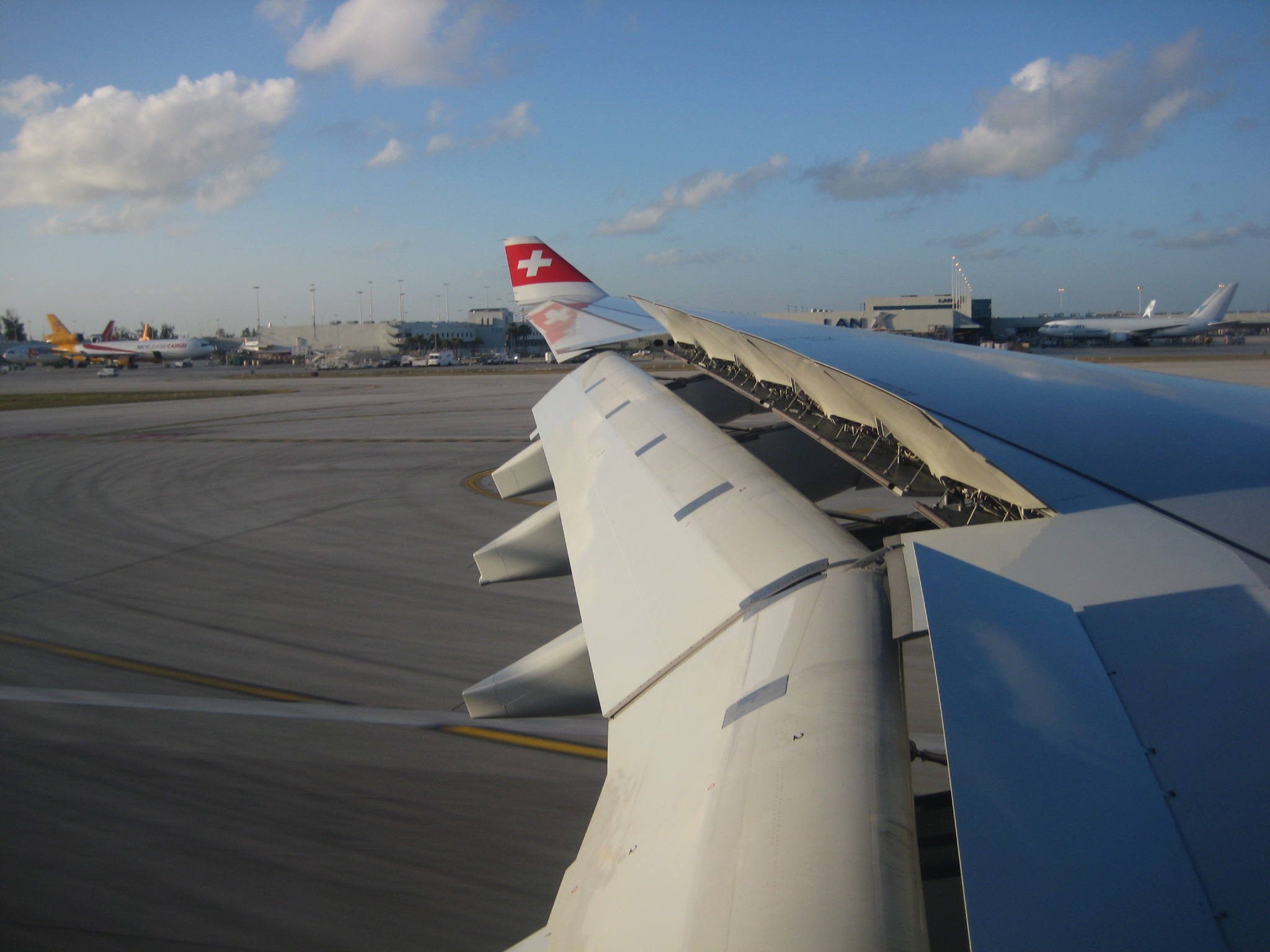
I arrive here on LX 64, a time-share inhabitant of seat 27A. 10 hours and 45 minutes wedged into a corner of a steel tube headed southwest. Right from the start though, something is different… but maybe it really is just the wind. We taxi to the wrong end of the main runway 16/34 at Zurich Airport, take off towards the northwest instead of the southeast, thankfully sparing me the standard-pattern, stomach-churning, nerve-deadening steep left-hand turn over the city at 500 feet AGL. (There are days when you wonder if thrust and lift really will deliver what they promise. Days when you think the wingtip is close enough to scrape the roofs of houses below. An engine failure here would be a human catastrophe.)

But this is an uneventful trip, as transatlantic journeys go. Vegetarian lasagna (bad choice) on my tray-table accompanied by Grammy-winner Lady Antebellum on the sound system. The Social Network entertains me for two hours and I spend time working on the To-Do list that will keep me occupied days, nights and in-betweens for the next couple of weeks.

Pick up luggage – my suitcase takes a long time to emerge from the airport’s intestines (despite the prominent tag that says “Crew”) – and walk out the big double doors that separate MIA airside from landside. Here I always get a knot in my throat, quietly wishing my father would be standing there, waiting to pick me up, like he did for almost 10 years… and that his death 3 ½ years ago was just a really bad dream. I’m always disappointed.

The time from wheels-on-the-ground to drink-in-hand is a respectable 103 minutes, but far from our record of 79 minutes. Traffic on I-95 sucks.

But now I’m here and relieved. Home. In a way.

My great adventure begins with a beachfront sunrise skate at 6am.