White folks, a school and recess.

20 05 2012

One hundred pairs of wide brown eyes stared at us like we had just landed in their corner of Ivory Coast from the moon: Two women with pale skin, smiling.
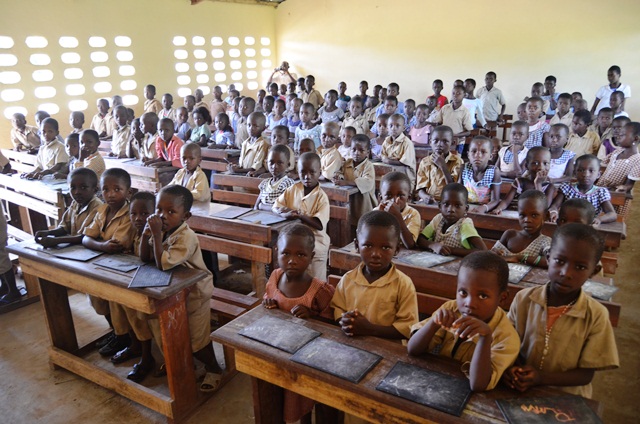
The classroom.

These two strange-looking women were accompanied by a third woman, carrying a leather handbag, who looked like they themselves did, or rather like their mothers, just better dressed. And better fed.

We felt a bit like we were in a zoo: the grown-ups showed us what was there, in the classroom, and the hundred kids got to take a good long look at what had just walked in the door.

The question was only – which of us was the caged animal?

Perhaps they had seen white people like us before, but likely only men, and only in a position of power. A foreman on a rubber plantation where their parents worked as day-labor, or a buyer for the cocoa that their parents harvested on their smallholder farm. In both cases the white man determined what they would eat, and if they could afford to go to school, or to a doctor. Today or tomorrow. Or never.

The principal of the rural primary school about 150 kilometers east of Abidjan opened his doors wide for the visitors from far-away Europe. The children stood for us, bade us good morning in unison, and then sang for us. And they stared at us. It was a strange feeling, being greeted like royalty, or the President.

A goat munched serenely on weeds near the flagpole. A natural lawnmower today, lunch (if necessary) tomorrow.

The schoolyard (with goat and woman).

The school has three classrooms for the 180 kids currently enrolled, a small office for the principal, housing for the teachers – including solar cells on the roof for electricity – and a water well in the barren schoolyard.

The youngest kids looked to be about 6 or 7 – the age where most children in most countries start school. But the one or the other stood much taller than her comrades. A teacher told us later that these were the kids who lived farthest away, and whose parents didn’t let them begin first grade until they were 10 or 11.

Some kids, the principal said, just do not show up during the harvest of whatever crop their parents or neighbors farm. Other children attend for a year, but don’t come back when the new term starts. The teachers are used to this, and have no choice but to accept it as part of this traditional, agricultural society, where child labor (and child slavery) is not uncommon. Often the parents are illiterate, and don’t know better.

During our visit, the principal promised the kids that if they are really good students, and work very, very hard, then someday they can get on a big airplane and fly to where these two strange-looking women came from.

The older kids laughed, knowing full well this was something that maybe a single lucky one of them might experience in a lifetime. The younger ones seemed more bewildered than anything else. They didn’t seem to find this funny – or a state to which they would really wish to aspire. An uncomfortable, confused silence followed. We kept the smiles pasted on our faces so that we didn’t have to say anything – because we had no words at that moment.

At mid-morning a small child ran out of one classroom, grabbed a stick and banged on the rim of an old truck tire that had been stripped of its rubber, hanging on a wooden frame in the middle of the schoolyard.
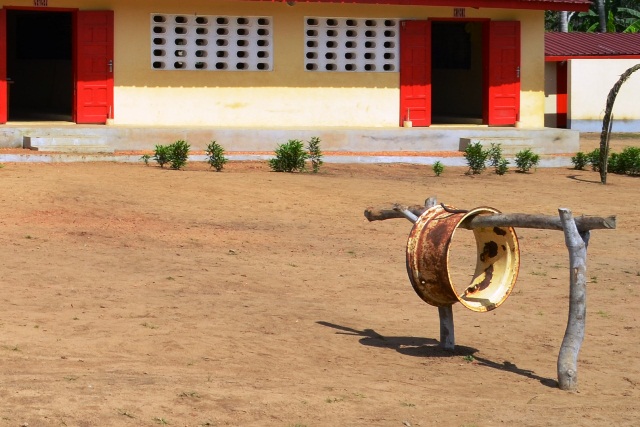
The bell.

And then we saw what happens at recess at probably every rural primary school in Cote d’Ivoire. And all over the world.

180 kids + break-time = boundless energy.




Three women of Africa

11 05 2012

The first woman is cocoa farmer, grasping a rare opportunity to learn.

On this overcast day she joins two dozen men of her community in an educational program that promises to help her grow more cocoa pods, and deliver higher-quality beans that will be used for exclusive foreign chocolate and enjoyed in sophisticated European capitals that she will never see. She hopes to apply the things she learns on her own farm, to generate a higher income, and build a better life. She squats on the ground in her flip-flops and mixes a pile of freshly shucked cocoa beans, up to her elbows in the white pulp that tastes a little like lychee juice.

She sings while she works.

Womens’ work.

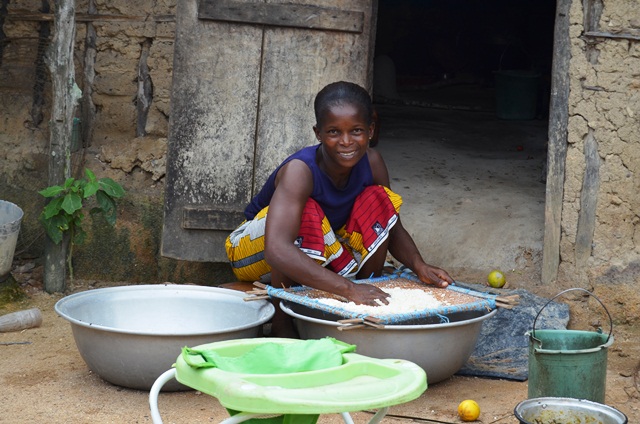
The second woman is a villager, grinding manioc on the doorstep of her mud-and-wattle home, to feed her family.

Her settlement is in a clearing in the rainforest, a red dirt piste the only connection to the main road, several miles away. To get there, we drive slalom around potholes wide enough to easily throw out an axle, and deep enough to easily swallow an entire car. These homes have no running water or electricity, and the roofs are made of dried palm leaves.

She tastes some of the chocolate we bring from far-away Europe. It is soft and runny, from the heat, but she takes a handful anyway, and sucks it off her fingers.

Womens’ work.

The third woman is not a woman at all. She is a child of maybe 13 or 15 years old, who has, herself, just borne a child, a few hours earlier. He lies next to her on the plastic-covered bed, stretching his arms skyward, to hug his new world, while she rests. The doctor at the rural health center tells us that the birth took place without anesthesia. “Natural childbirth,” they call it here. To get to the clinic at the top of the hill she had to walk. Her own mother, barely 30, accompanied her. She is now a grandmother.

I did not photograph them.

**********

These are three of the women I met last week in Ivory Coast, a country of 21 million inhabitants nestled between Liberia and Ghana in Western Africa. “Met” is perhaps an exaggeration. I don’t know much more about these women than the basic facts I have written down here, hastily scribbled into my reporters’ notebook at the time. I don’t even know their names. We exchanged a handshake, a “Bonjour madame!”, a smile, and a laugh at something silly. Our worlds touched briefly, with that bond dispersing a short time later, just as quickly.

These are three of the strong women of Africa.

She is the backbone of her community, she is the keeper of her family. Here in the rural communities of the Ivory Coast, she learns from an early age that she must embrace hard physical work to survive. And that she must endure the constant machismo of a traditional male-dominated society, where polygamy is regularly practiced and inheritance usually only passes to her brothers. She bears these lifelong hardships with dignity.

Every day she has a million miles to go before she can sleep.

This was my first visit to Western Africa, and it will surely not be my last. My body returned to Europe this morning. My soul is having a hard time keeping up.

Womens’ work.


Screaming kids on airplanes

27 04 2012

So just because I love jetlag so much, I decided to go back to the States five days after I had just returned to Europe. Chicago last week, New York this week. But more about NYC another time, maybe.

Today I want to talk about children (again).

There is nothing on earth that brings the sociopath out in everyone than screeching, red-faced midgets on a transatlantic overnight flight.

I thought that my JFK-ZRH flight would be a good opportunity to get at least a few hours of shut-eye. Oh how wrong I was. Within the five rows around me there were seven kids ranging in age from about six months to 3 years.

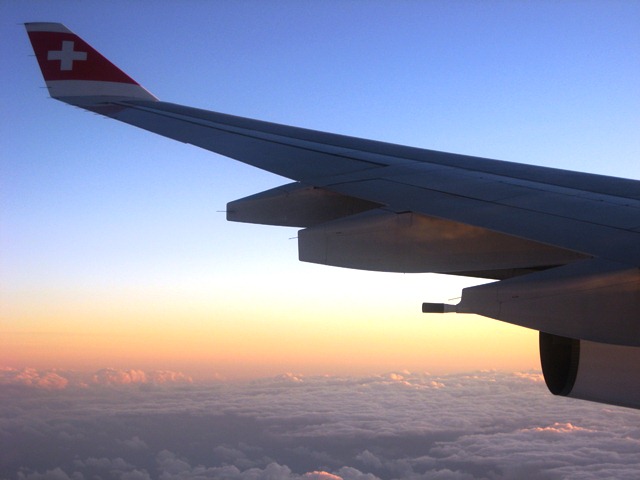
Children in front of me, children to the right of me, children behind me.  There were no kids to the left of me because there was only a window, and beyond that, an airplane wing. And if you ask me, I would have put them all there rather than in the cabin with the rest of us.

The best place for kids: Outdoors!

Yes, attached to these children were also parents, all of whom seemed incapable and overwhelmed with the stress of parenting.

It’s bad enough when one child screams incessantly in a closed space with a captive audience of 200. But on this flight, they all screamed. Throughout the night. In a coordinated attempt to drive all the rest of us to commit extremely violent crimes.

Jethro Tull on the inflight entertainment system, at top volume, could not drown out these pint-sized terrorists.

My martyrdom (and that of my child-free co-passengers) lasted seven hours, thanks to a strong tailwind that got us to our destination faster than usual, plus 45 minutes of taxiing at both ends.

What can be done? I have three solutions:

  1. Completely child-free flights. Malaysia Airlines has the right idea, having banned infants from its First Class cabins and implementing a child-free upper deck on its new A380 aircraft from July 1. This is an idea whose time is way overdue. Folks like me who have to go from the gate to the office after an overnight flight will not stand for this kind of noise pollution much longer.
  2. An “objectionable noise surcharge,” kind of like the fuel surcharge all of us have gotten used to paying. The younger the child, the higher the tax. This would automatically disqualify families traveling with multiple infants because they would likely no longer be able to afford it.
  3. A sound-proof cabin at the back of the plane. Like a playpen, or a time-out box. Or just seal off the last five or six rows from the rest of the cabin with sound-proof glass. They used to put smokers at the back of the plane, and now we can just put kids there. Screaming (like smoking) is harmful to the environment and the health of all those individuals not currently engaged in it.

OK, time for all you parents with young kids to come at me with a machete. But you know darn well that I am right.  You have to deal with your own screaming kids all the time. You can’t escape them. (And don’t you wish you could?)

But ask yourselves this: Why must babies travel to other continents before they even know who they are? Why do you people drag them across oceans and time zones when they won’t remember any of it when they grow up? Why do you expose them to foreign germs and the misery of jetlag before their first day of school?

A suggestion that could keep all of us happy, the child-rich and the child-free: Show your kids your own country or region or continent when they are really small. There is so much to see in Europe, or North America, or Asia, alone. Then, when they turn six, or seven, or eight, when they are old enough to appreciate what you are offering them – that’s when you begin to show them the world.


Oh, Chicago!

15 04 2012

One of the Dalai Lama’s rules for living a good and wholesome life is: Visit at least one new place a year. Or something like that.

So I went to Chicago.

The view from my hotel window on the 22nd floor.

I had never been to the mid-west, other than changing planes at O’Hare once, maybe 15 years ago. (With the exception of a week-long trip to Winnipeg for my best friend’s wedding in 2000. But that’s Canada. Doesn’t count.) And I will be honest, Chicago was not really at the top of my list of new places to go. It just so happens that the company I work for has its U.S. headquarters there, and the company sent me on a business trip. So I went.

As your typical Northeast-Mid-Atlantic-I-95-corridor-sophisticate, I never gave my country’s heartland a second thought. All these years I thought there was just lots of white space and corn fields and cowboys between where DC ended (Georgetown) and the San Francisco Bay Area started (Berkeley). Heck, until five years ago, I had never even been to San Francisco, either. So here I thought there was just 3,000 miles of nothingness between the left and right coasts. I guess I started taking note of Chicago when Barack Obama emerged as a potential presidential candidate in 2007-ish. But I never really felt like I had to go there.

So on my first trip to Chicago, I arrived last Sunday with zero expectations and was open for, you know, whatever. And I was really impressed. The first Chicagoan (or is it Chicagoite?) I met was friendly and  helpful, showing me how to use the ticket machines to buy a fare on the L. The second one I met, as I got on the train, wished me a great time in his fair city.

I called an old friend of mine I hadn’t seen in more than eight years – a native of the South Side who moved back after years away to work as a television producer for a major national network. He drove me up and down Lake Shore Drive, showed me all the sights – at least from afar – and fed me a Chicago deep-dish pizza (basically a cheese quiche with a half-inch of tomato sauce on top) in his neighborhood pizza parlor, as we caught up on each other’s histories.

On day two he took me to the 27th floor of some ritzy downtown hotel and we drank very expensive whiskey and prosecco while gazing out the floor-to-ceiling windows, as twilight fell upon the bustling city below and all around us.

The Loop from high up.

(Yes, I did go to the office, too, and met lots of really nice folks there as well. Mid-westerners, mostly.)

What a great surprise, getting to know this cool city under brilliant springtime sunshine, as well the wind that gives the place it’s nickname. Giving rise to the thought that I’m not sure I’d want to spend a winter there.

And I realized once again that the Dalai Lama is a really smart guy.


The curse of the single second

5 04 2012

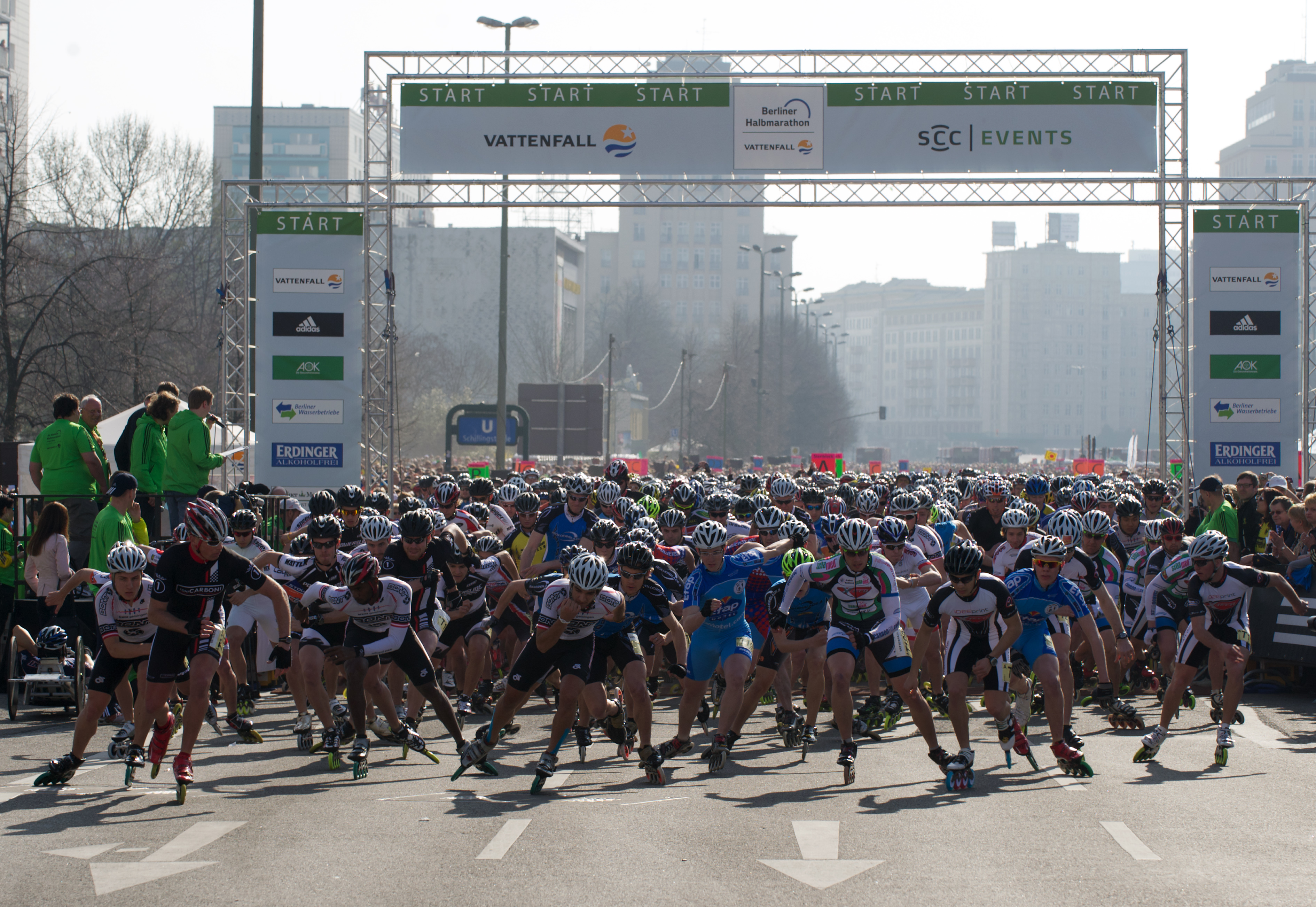
Last weekend, Berlin was a festival of sight, sound and fitness. It was the moment when everyone crawls out of their winter hibernation to kick off the skate and running race season in one of the most exciting cities in the world.

GO!

It was my 11th Springtime sightseeing tour through the German capital, and I lined up with more than 1,800 others on wheels (the 25,000 runners started half an hour after us) under a brilliant blue sky and heartwarming sunshine. The streets were dry after Saturday’s brief but intense snow squalls, and it was really, really cold – about 3 degrees C (36 degrees F) – as we waited in the starting area for the gun to go off.

And standing there, warmed by the body heat of almost 2,000 other adrenaline-pumped athletes, none of us really had any idea what kind of gusty headwinds we were in for along the route.

In my last posting I said I was aiming for a time between 50 and 55 minutes. I came in at 57:01. Not brilliant, but not bad either.

So what’s my excuse? I have three.

1) I turn 42 years old next month. ‘Nuf said.

2) The streets. There is a reason Berlin’s unofficial city motto is: “Poor, but sexy”. (Many potholes = many reasons.) At least I did not leave a layer of epidermis on the asphalt like a number of other folks did.

3) The wind. A question for all you athletes out there: have you ever noticed that no matter which way you run/skate/ride your bike, that the wind is ALWAYS coming from the wrong direction? And I’m not talking about the wind in your face that comes as a result of speed. We are talking about near-tempest-like-conditions that hit you like a brick wall. Pay attention next time. You will discover that I am right.

My placement in my age group was about top quarter. That is the expectation I have of myself, and that at least has been relatively consistent since I started doing this kind of thing when I was in my 20’s.

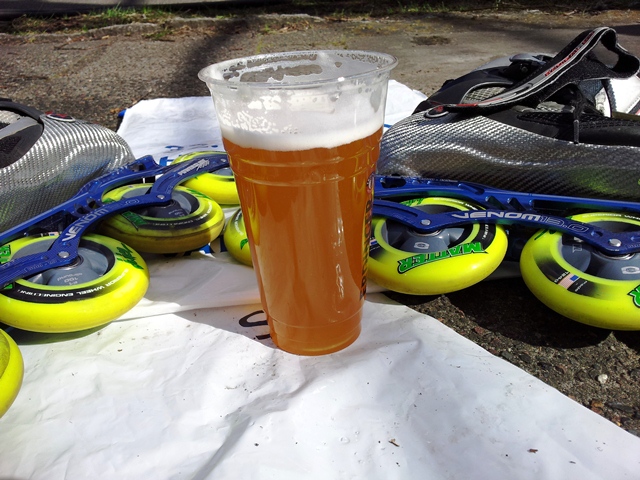
My reward after a hard day's skate.

It’s that single extraneous second though, offensively and provocatively hanging off the end of my total time, 57:01, that is really starting to annoy me. Loyal readers will recall that my marathon time last year (a personal best, by the way) also had a single second dangling off the end of it (1:40:01).

It’s one thing to miss a lower minute-result by a whole lot, like, say, 19 seconds or 34 seconds, or 47 seconds. It’s another entirely to realize that you could have made it in under the wire if only you had skated just a smidgen faster. Something like 0.09 seconds faster per kilometer. In other words, next to nothing.

Grrrrrr…….