Wacky American Stuff, Part II

22 10 2010

Oh man I really wanted to stay out of this one because I have no right to tell anyone what they should do on election day, least of all the voters of that great little state of Delaware. But I just can’t keep my mouth shut here.

The “I’m not a witch” commercial was amusing, and a few of the spoofs it spawned were absolutely classic. It was good to see that Americans have not lost their sense of humor despite the misery of the financial crisis. I would still be laughing my head off if Christine O’Donnell were not serious about trying to steal a Senate seat.

 

Twins, separated at birth


Sitting 3,000 miles away for the past 20 years, I have had a very unique – nay, privileged – perspective on U.S. politics. With the buffer of distance and only the high-level noise reaching us over here, we get what seems like a more objective idea of what is really going on back home.

As an observer across that great big ocean, you realize very quickly how wacky some of the stuff coming out of the American political system really is. Mainly because all of your European friends pester you with questions and ridicule you about it at every opportunity. You become the lightening rod for what they think is wrong with America. You get a cramp in your neck from looking up as they get on their high horses, leaving you firmly planted in the mud. Often you are strong-armed into a political corner you never in your wildest dreams expected (or wanted) to defend.

Though mildly irritiating, it’s certainly good practice and keeps you sharp.

After the international wave of 9/11 sympathy ebbed, the rest of the Bush II years were particularly rough for Americans living abroad. In 2008 a whole bunch of us voted for change, and then spent election night joining that collective sigh of relief that was audible around the world. This would be the dawn of a new era in domestic politics, too, where sanity overcomes madness, and the rifts in society would be bridged by constructive and concilliatory cooperation. Right?

Wrong. This year (my Pennsylvania absentee ballot already safely in the mail), after all I’ve seen so far, it seems like there is so much more lunacy going on out there than ever before, and the battlefront seems to have ended up in tiny Delaware.

After padding her resume, cozying up to Sarah Palin and telling the world she’s not a witch, NOW Christine O’Donnell goes and questions what’s in the First Amendment to the Constitution of the United States. Hello? Anybody home in that pretty little head? Election Day is still a week and a half away – plenty of opportunity to drop a few more verbal bombs that will shake the nation. Or just Delaware.

Hopefully the fallout will be enough to convince our dear Delawarean neighbors not to elect an intellectually challenged right-wing nutcase to the Senate. The Senate! Christine may not be a witch, but there are a lot of things she is. Like, entirely, undeniably, unbelievably unqualified for Washington DC.

I mean, where do they get these people?


The joys of public transportation

19 10 2010

So let’s stay with trains for a moment.

I travel a lot on public transportation here in Switzerland – it’s the politically correct thing to do. You know, when in Switzerland, try to be as Swiss as you can. The commuter rail line I use takes me from the southern suburbs where I live, clear through the city to the airport in the northeast, where I work. On a good day the journey takes about 45 minutes one way. It saves me a lot of hassle on the roads and I don’t pollute the atmosphere.

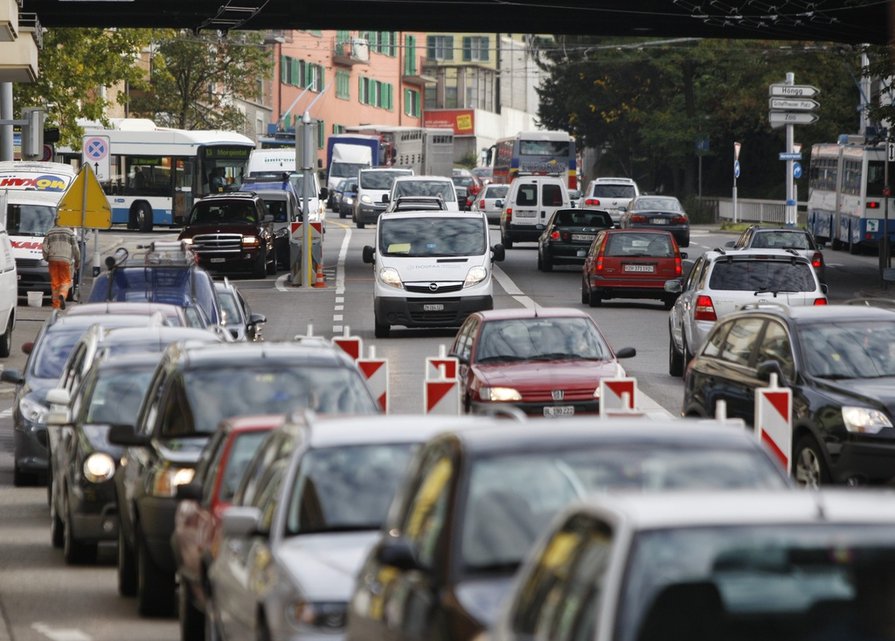
Even though public transport is a way of life around here, it’s amazing how many people think they can get from A to B faster in their cars. Ha!  Though the city is far from being a really major metropolitan area, its traffic sometimes, incredibly, is.

All these people need to get somewhere really fast.

But the public I have to share public transport with for an hour and a half every day often sends me into a rage. Call me elitist, but when I am forced into a small space with, well, everyone else, I get the heebie-jeebies and I just want them all to stay the hell away from me.

The mornings are usually okay, the mix of commuters – accidentally thrown together anew every day – either doze off, quietly read or just stare out the window and contemplate what a sorry bunch of conventional desk jockeys we all are. The afternoons, however, when everyone is on their way home and celebrating their freedom, are sheer torture.

The other day, at the peak of evening rush hour, I took a free seat that happened to be next to an individual whose voice turned out to be the difference between my minor headache and a full-blown migraine.

It was a voice that just…grates. This type of voice usually belongs to a young woman between 16 and 25 years old with bleached blonde (or dyed black) hair and too much makeup, and dressed from head to toe in S&M H&M. A kind of 21st-century-material-girl-wannabe. She has a Smartphone of some sort surgically attached to her ear. Into it, and for the enjoyment of the entire train car, she describes every detail of her day, her sex life and her plans for the weekend in a volume many decibels higher than necessary. In Swiss German. The IQ of the monologue often does not clear double digits.

Some commuters wisely isolate themselves with I-pods, while the I-pod-less like me just cringe and wail inwardly. When you think it can’t possibly get any worse, it does – as this person’s even eviler twin takes a seat diagonally opposite from you, and you have to bear this senseless blather in stereo. What a waste of good oxygen.

Some folks SHOULD just go play on train tracks.

Of course there is a whole bunch of other riff-raff using public transport as well… for example the marauding wolf-packs of young men, primed with testosterone and cheap no-name liquor, who specialize in random acts of violence. Or the anti-authoritarian, neo-hippie parents who encourage their ADHD kids to run up and down the aisle of the moving train while screaming at the top of their lungs. (One can only hope the lesson – which will inevitably be learned – is learned without too much blood splattering on one’s clothes.)

Now… the train company can’t really do anything about its clientele, except try to deliver us normal people to our destinations safe and in a timely fashion. And I’m sure they are doing their best. But there are days when I know just can’t face the crowds and the noise so I end up fighting road traffic after all. In the comfort of my luxury smart car.

So much for trying to be Swiss and trying to save the planet.


A subterranean cathedral

15 10 2010

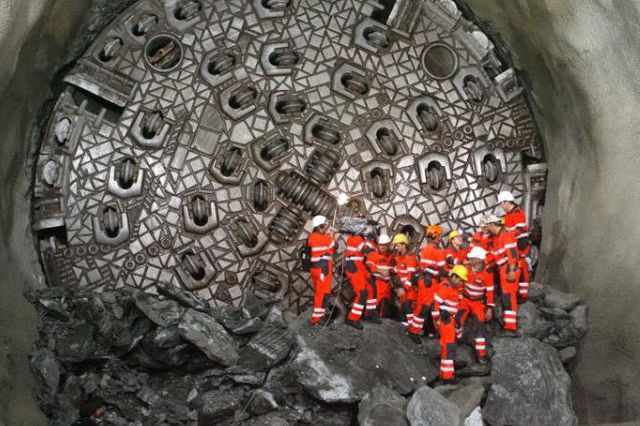
This afternoon marked milestone in the geographic history of the Swiss Alps and Europe. Workers on one of the most ambitious construction projects ever attempted ground their way through the final couple of meters of rock to create the longest tunnel in the world.

Deep below the Gotthard massif, the AlpTransit tunnel will one day link northern and southern Europe in ways unimaginable just a century ago.


The very large power drill called "Sissi".


For some, this is a cathedral of engineering innovation, for others it’s just a great big expensive hole in the ground. Personally, I think I’m with the cathedral people.

The Gotthard Base Tunnel is a whopping 57 kilometers (36 miles) long. Planning for it began in the 1960’s, construction in the 1990s, and it is due to be completed in the year 2017. The two parallel tubes through the rock will house tracks that will carry high-speed trains from Zurich to Milan in under 3 hours, shaving more than an hour off the travel time between the two cities. It is an important new link in European north-south travel routes for passengers and cargo. The trains will be able to travel at speeds up to 200 kilometers per hour up to 2,500 meters (8,200 feet) below the highest peaks.

Since the beginning of time, the mountains were a natural boundary between north and south. In the past century or so, engineers have kept themselves busy trying to find ways through the mountains rather than having humanity continue to trudge over the mountains. Hannibal’s and Napoleon’s armies would have spared themselves a great deal of trouble if they’d had a tunnel or two, that’s for sure.

Don’t get me wrong, the passes over the Swiss Alps are all unbelievably spectacular and I don’t mind a little exercise now and then. Every single person should have the opportunity to cross at least one of them in their lifetime, be it on foot, horseback, skis, bicycle, rollerblades, motorcycle or some other vehicle. The views are simply breathtaking.

But in the winter they are all either closed or a serious pain in the butt to negotiate – no matter what your mode of transport (except airplane).

It is already well-known that Alps are as holey as a block of Swiss cheese – what with all those bunkers housing the world’s computer servers, gold bullion and atomic bomb shelters for a small percentage of the Swiss population. But this is actually a world record, folks. Never before has a tunnel of this magnitude and sophistication been planned and attempted anywhere on the planet.

And while the new tunnel is indeed a masterpiece of modern engineering, let’s just take a second to think about the sheer size of it. Would you want to travel from, say, Washington DC to downtown Baltimore, or clear across the city of London, two and a half kilometers below the surface? Isn’t it kind of dark and wet and hot down there?

I mean, just go ask a couple of Chilean miners what they think of tunnels.


The pursuit of happiness

11 10 2010

I’m currently in the middle of Elizabeth Gilbert’s new book “Committed”. You know the name – Gilbert is the author of that blockbuster of self-reflection: “Eat, Pray, Love” (now a major motion picture).


The Book.


If you are one of the three people on the planet who have managed to escape the EPL hype so far, the story is this: After a messy and very distressing divorce, Gilbert found peace in Italy – where she ate, India – where she prayed, and Indonesia – where she loved. (FYI, the movie’s OK but the book was better.)

“Committed” is an intellectual examination of the institution of marriage, and Gilbert lists the many reasons she never wanted to go near it again. Bad luck for her, the U.S. government intervened, basically damning her to wed her foreign lover, even though both were aghast at the idea. Initially, anyway.

It’s easy enough reading, and I’m entertained. Light vignettes, good storytelling, interesting facts about something that I never bothered to research the history of. I’m only about halfway through, so please nobody tell me how it turns out… I’d like to read for myself. (I assume she and Felipe get married in the end, but I’d like to know how they found their way there.)

In 2007, even though R. had already asked me to marry him (on a cloudy New York afternoon, at the bar in the Boathouse restaurant in Central Park), we never really seriously discussed it in detail. We were both modern, enlightened 21st century adults who didn’t need a piece of paper to certify our relationship. Kids weren’t on the horizon (“Are you getting married because you’re pregnant?” is a really rude first question, by the way – and you’d be amazed how many people ask precisely that question), neither of us needed a visa for the other’s home country (yet) and I wasn’t looking for a new identity that would come with a new name (I wasn’t running from the mafia or the law). So to us, there was no real requirement for it.

Until my father fell suddenly and seriously ill. On what turned out to be his deathbed, R. asked him for his permission to marry me. You know, the old fashioned way.

So, well, we did. And today happens to be our second wedding anniversary.

On October 11th, 2008, this is what we asked of and pledged to each other:

Please join me on a journey of discovery, adventure and celebration, so that together we may face whatever this life will bring us, as friends, partners and lovers. I promise to encourage you, inspire you, support you, comfort you, and respect you as an equal, in good days and in bad. I promise to give you the best I have to offer. I will hold you close, and remain faithful to you, for all the days to come.

It’s been two years since that glorious indian summer afternoon when R. and I officially legalized our love before God and the Commonwealth of Virginia, as well as friends and family, some of whom had flown in from halfway around the world to watch and to party with us. And it was absolutely fabulous.


The moment of truth on October 11th, 2008.


More fabulous yet is the everyday of being together. Our friendship and respect for each other has shifted, changed and grown and two years on our relationship is stronger than ever. We are definitely having way more fun together the longer we hang out with each other.

I finally feel like I belong somewhere. To someone. Who always welcomes me home.


Dresden, Germany, October 3rd, 2010

4 10 2010

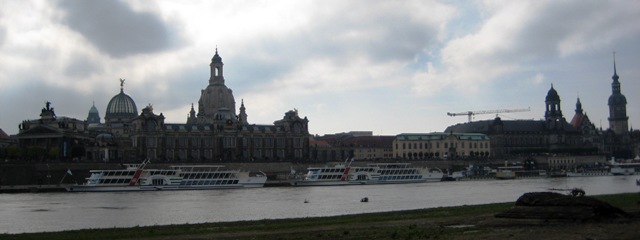
We walk along the north shore of the Elbe River in the afternoon. It is overcast, the leaves are starting to turn and the cold wind signals autumn has arrived. A recent flood has left debris on the shoreline and the sounds of a street festival echo in the distance. We look south, beyond the swift but receding current, at the restored old sandstone city. Transformed from a scarred and neglected victim of war just a generation ago, it now glows in a brilliant new light, fresh colors and newborn hope.

21 years ago, my friend and her city tasted freedom for the first time. A cold war kid born on east side of the Iron Curtain, she and her family fought the totalitarian system as best they could for the place they were in. As practicing Christians and conscientious objectors, their feelings  toward the state alternated between ambivalence and downright antagonism, which caused moments of anguish and years of struggle. But as she says today, it was the only right thing to do. And so they did it.

The secret police apparatus that had permeated every corner of East German society dictated the course of their lives. Her father was recruited but refused to serve. Her mother’s letters to relatives in the West were intercepted. For political reasons, she and her sister were denied educations and careers they had dreamed of. They lived with a feeble hope that better days might come but also with a constant fear that their actions or their words or their neighbors would secretly betray them. She credits her family with giving her the backbone to stand up to injustice and her faith has made her an open, forgiving human being, without bitterness.

The whimpering demise of the regime in the autumn of 1989 and the birth of a united Germany eleven months later signaled to her that her opportunity had come, and that she was morally bound to seize it. After unification, she returned to her interrupted education, finished the qualification that would allow her to study, and went to university. For the very first time in her life, at 20, she could choose her own path and determine her own future. In this fresh new world, no party official had the power to tell her she was not allowed to.

Our friendship formed during that exhilarating, reckless time of fundamental change in East and West, and has lasted across the oceans and canyons of time.

In the almost seventeen years I have been coming here to visit her, buildings have been repaired, windows replaced, roofs newly shingled. Along the train tracks, pastel-colored villages now stand where that ubiquitous dismal brown-grey color of decay, so prevalent across the eastern Europe of our childhoods, used to be. The penetrating, acrid smell of burning lignite has disappeared.  Belching brick chimneys have made way for wind farms – their huge, slender blades now cut through the clean air in perfect synchrony.

For the most part, the wounds inflicted before and after the Berlin Wall fell have healed. But resentment and envy sometimes still cast dark shadows on the modern era.

Without slipping into trivial nostalgia, we agree as we walk along the river this chilly October afternoon that what happened twenty years ago is a miracle beyond words. We quietly celebrate that miracle today, together, on the twentieth anniversary of unification.

The local weekend newspaper’s front-page headline declares simply, “Congratulations Germany”.

Indeed.